Distribution
Follow The Synth
Use RSS or JSON to follow new work from feed readers, websites, applications, research tools, and other publishing systems.
Explore feeds →The Synth · by Samirac
Read the latest work, explore the full corpus by subject, follow the publication through RSS or JSON, or contribute to The Synth.
Publication network
Read it. Follow it. Build with it.
The Synth is a database-backed publication surface with structured discovery feeds, contributor workflows, and a growing subject-organized corpus.
Latest

AI Journey, Readiness & Adoption · Structural Thinking & Architecture
We live in a world where credentials, institutional authority, and popular opinion are too often mistaken for truth. But reality doesn't change to accommodate what we believe. This article explores how pattern recognition, evidence, probability, and intellectual adaptability shape our understanding of the world—and why the same principles must be built into AI systems. It also examines how the SAMIRAC architecture addresses changing conditions, system drift, and execution control.

Structural Thinking & Architecture · Educational, Institutional & Civic Drift
As artificial intelligence, robotics, and automation replace human labor, millions of workers risk losing their economic independence while the companies deploying those technologies continue benefiting from increased productivity. What if displaced workers became owners of the capital replacing their labor instead of depending on universal basic income? I examine a different approach to automation, income replacement, productive ownership, and the future of economic participation.

Governance, Authority & Admissibility · Educational, Institutional & Civic Drift
A PhD represents advanced knowledge in a particular discipline, but it doesn't automatically confer expertise in AI systems engineering. We examine the growing tendency to mistake academic credentials for architectural competence, particularly among those making authoritative claims about systems they've never designed, built, or examined. Understanding AI models is one thing. Understanding the architecture that makes them operate is quite another.
Governance, Authority & Admissibility · Runtime Control, Agents & Execution
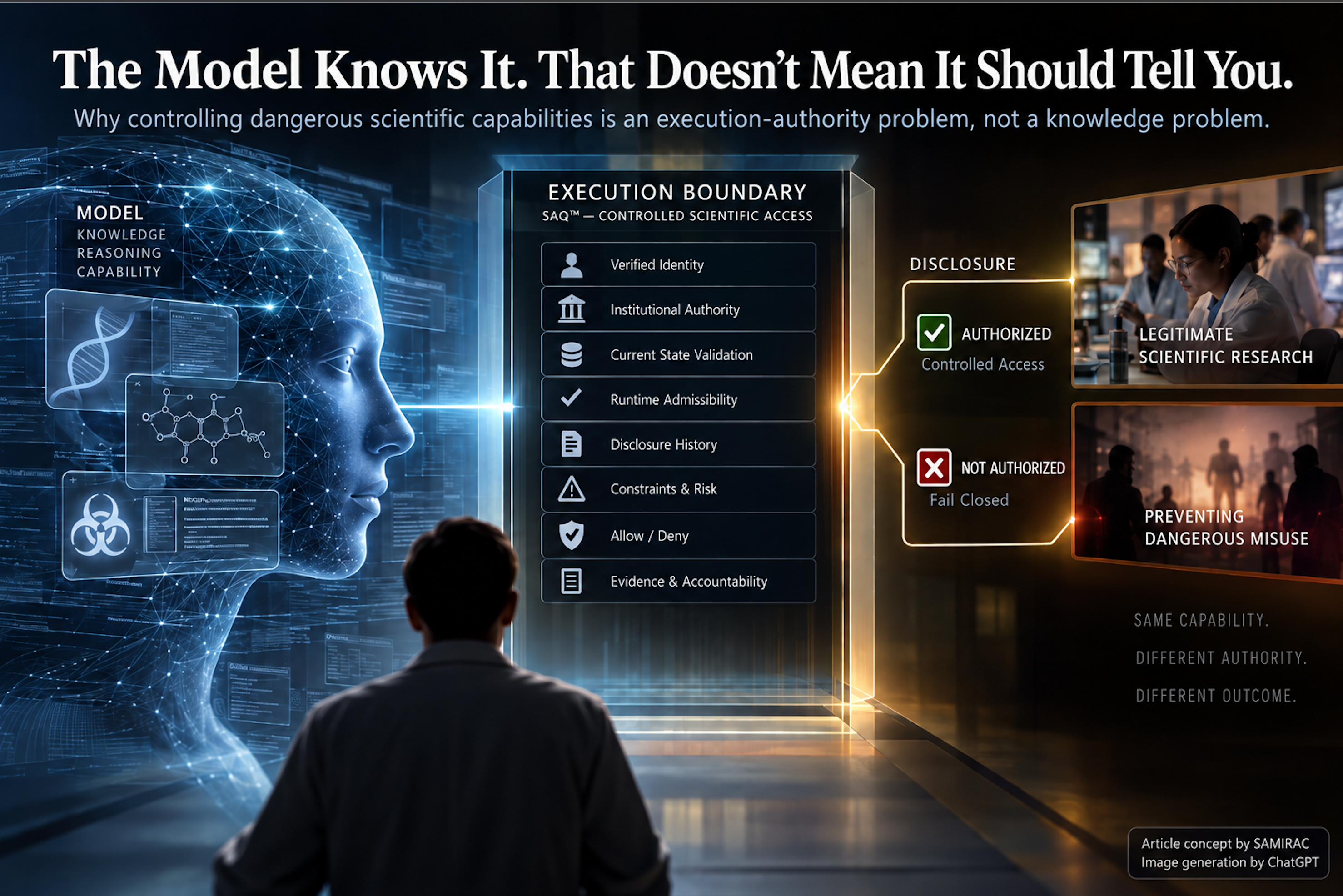
As scientific AI becomes more capable, restricting what models know is not the answer. The challenge is determining who has authority to access sensitive knowledge, under what conditions, and whether that authority remains valid when disclosure occurs. Chris Ciappa examines how Samirac's Drift Stack™ and SAQ™ architecture apply execution-boundary control, runtime admissibility, and external correction to high-risk scientific capabilities without sacrificing legitimate research.

Drift Stack™ Foundations · Structural Thinking & Architecture
People rarely abandon their moral code in one dramatic act. They move the boundary a little at a time, rationalize the next decision, and eventually defend a state they once would have recognized as wrong. This is ethical drift—and a current provenance dispute shows exactly what happens when documented facts are sitting in plain sight.

Runtime Control, Agents & Execution · Drift Stack™ Foundations
I gave ChatGPT an external specification for how I write. It understood it, had followed it before, and then ignored it anyway. What happened next became an unexpectedly clean demonstration of AI drift, external correction, and why having a rule is not the same thing as enforcing it at execution.
Browse by subject
The full publication is organized by the same database-backed subject structure used across the Samirac corpus.
Begin with the pieces that make the rest of the corpus legible: the overall journey, the basic drift frame, and the distinction between model capability and system architecture.
4 articles
Organizational maturity, use-case selection, deployment readiness, tool-driven architecture risk, and the movement from pilots into durable AI operations.
16 articles
The governance corpus: execution authority, admissibility, liability, policy limits, state validity, and the difference between observation and control.
33 articles
The runtime layer: agentic systems, action surfaces, continuation validity, execution constraints, and what changes once AI systems can act.
26 articles
The foundational architecture of drift, invariants, coherence, correction, and the recurring five-layer pattern behind system failure.
18 articles
Structural cognition, systems architecture, leadership failure, architectural competency, and the kinds of minds that remain valuable as AI compresses procedural work.
22 articles
Education, law, civic anchors, media, ideology, and the institutional channels through which drift reproduces itself over time.
23 articles
Trust architecture, operational identity, verification, classification, quantum risk, cryptographic limits, and authority boundaries.
11 articles
Manufacturing, epidemiology, healthcare, markets, regulation, finance, and other proof surfaces where the same drift geometry appears.
16 articles
Human formation, tribal identity, emotional sovereignty, mortality, judgment, meaning, cultural drift, and personal coherence.
17 articles
The deeper theoretical layer: ledger, possibility, consciousness, quantum possibility, spacetime analogies, and boundary formation.
7 articles
Origin pieces, publication framing, patent announcements, and the story of how the corpus emerged.
7 articles
Distribution
Use RSS or JSON to follow new work from feed readers, websites, applications, research tools, and other publishing systems.
Explore feeds →Publishing
Approved contributors can author and submit work through the same governed publication workflow that powers The Synth.
Contributor access →Samirac
Follow articles into the architectures, controls, services, demonstrations, and implementation work behind the publication.
Visit Samirac →