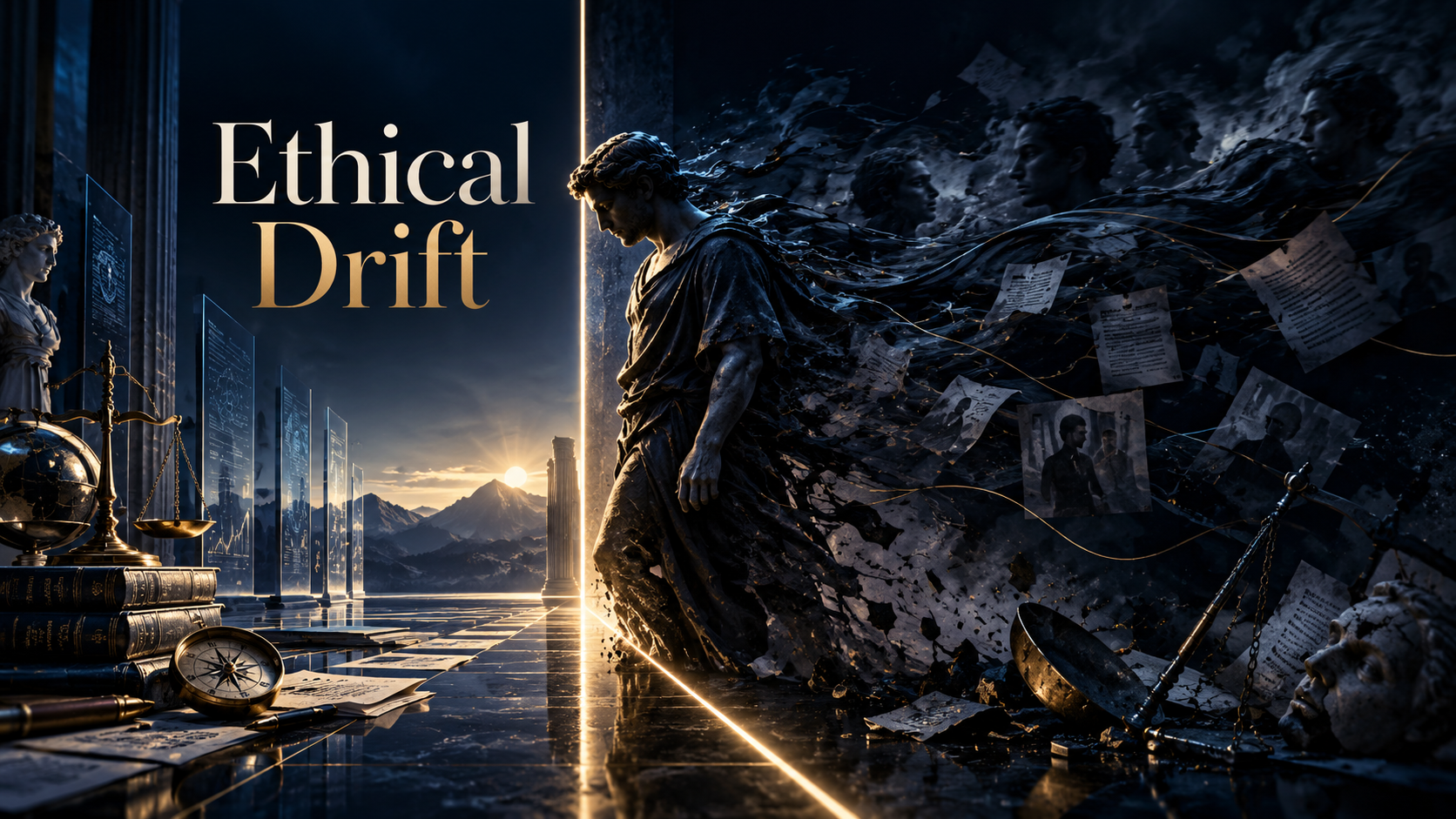
I spend a lot of time writing about drift in AI systems, but drift is not an AI problem. It is a systems problem, and human beings do it too.
Think about how somebody gets from knowing something is wrong to defending it anyway. It usually is not one enormous decision where they suddenly throw their moral code out the window. It moves a little at a time.
Something becomes inconvenient to admit, so they rationalize it. Then the next decision has to accommodate the first one. After that, another explanation is needed to preserve both of them, and pretty soon the person is no longer evaluating what actually happened. They are maintaining the state they created.
That is drift.
I have been thinking about this a lot because conscience is actually pretty uncomplicated before we start arguing with it. Most people know when they are lying. They know when they are hiding something material. They know when they have wronged somebody. They know when somebody else's work came before theirs, and they certainly know when somebody has put dated documentation directly in front of them showing exactly that.
You can argue around facts. You can delay dealing with them. You can tell yourself you need another look, another explanation, another review.
The facts do not move.
At some point, "I need to examine the evidence" stops being caution when you have already examined it.
That distinction matters.
If somebody walks up to you and says, "You stole my work," with nothing to support it, fine. Demand proof. Ask questions. Make them show you exactly what they are talking about.
But once they give you the dates, the publications, the earlier architecture, the chronology and the underlying record — and you acknowledge in writing that you read it — the situation is different.
You cannot indefinitely say, "Let the evidence establish what happened," while the evidence is lying on the table in front of you.
What exactly are you waiting for at that point?
That is where ethics stops being something we say and becomes something we have to do.
Conscience knows right from wrong.
Integrity is what happens next.
Ethical Drift Usually Looks Reasonable While It Is Happening
This is what interests me about human drift.
It almost always has an explanation.
"I want to be careful."
"I don't want to make assumptions."
"I need to review the material."
All perfectly reasonable statements by themselves.
The problem begins when those statements become a mechanism for avoiding the consequence of what has already been established.
You cannot keep announcing that you intend to look at evidence every time the evidence produces an answer you do not particularly want.
Eventually the question is no longer whether you have enough information.
The question becomes whether you are willing to act on it.
And that is where character shows up.
Doing the right thing when it costs you nothing is easy. Character gets tested when the truthful answer requires you to give something up — some pride, some perceived originality, some business advantage, some story you have already told yourself or other people.
That is the moment where the boundary either holds or it moves.
Once it moves, the next move becomes easier.
That is exactly how drift propagates.
Here Is a Real Example
I am going to use a current situation because it illustrates the point almost perfectly.
In July I contacted AI governance researcher Rajashri Pattanaik concerning substantial architectural overlap between work she was publishing and earlier dated Samirac work involving execution authority, admissibility, temporal authority, identity, current state, multi-agent execution and the execution boundary.
Her public profile is here:
https://www.linkedin.com/in/ACoAAFpgybMB_3uBYKYo4rEg8-_uGy5Sp07g2Go
I did not contact her and simply announce that she had copied me. No I absolutely did not.
I did what any creator might do, I simply asked for provenance. That is an important distinction because if the architecture had developed independently, show me the dated record. Show me the drafts. Show me the research. Show me the architecture existing before mine or published posts, github receipts, something developing independently alongside it.
That is precisely what provenance is for.
On July 29, I sent her a detailed comparative provenance review.
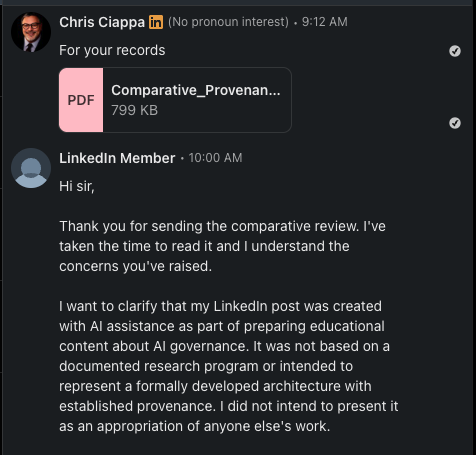
Her response was very clear:
"Thank you for sending the comparative review. I've taken the time to read it and I understand the concerns you've raised."
She then explained that the LinkedIn post at issue had been created with AI assistance and "was not based on a documented research program or intended to represent a formally developed architecture with established provenance."
She also said that if the post should be clarified, revised or include acknowledgment of relevant prior work, she would make those changes.
I accepted that response.
In fact, I told her I considered the matter resolved on that basis because the solution seemed obvious enough: preserve whatever was legitimately developed independently, acknowledge the earlier source where the overlap was substantial, and keep the lineage straight.
That was July.
Then the work continued.
By September, the later material had developed into CCEAF — the Continuity-Constrained Execution Authority Framework — including temporal execution authority, current admissibility, mutation continuity, multi-agent aggregation, authority continuity and a protected execution boundary.
At that point I documented the chronology again, assembled the evidence side by side and placed it in front of her again.
Her response was that she wanted to "carefully review the dated materials, the technical substance, and the relevant provenance records" before making a public acknowledgment.
But this was no longer the first review.
That is the entire point.
The provenance material had already been delivered in July.
She had already confirmed that she read it.
She had already stated that the earlier post was not based on a documented research program with established provenance.
Whatever uncertainty might have existed about whether she knew of my work before July ended when the record was delivered directly to her and she confirmed reading it.
From July 29 forward, notice is not speculation.
It is documented.
And yet months later we are back to "I need to review the evidence."
This is exactly what I mean by ethical drift.
At Some Point, Review Becomes Avoidance
There is nothing unethical about independently arriving at an idea somebody else already had.
That happens constantly.
There is also nothing unethical about disagreeing over where two bodies of work overlap.
But once prior work is placed directly in front of you, dated and documented, your obligations change.
You now know it exists.
You now know when it existed.
And if your later work materially occupies the same architecture, the honest thing is not particularly complicated: acknowledge what came before, cite it, and clearly distinguish whatever you genuinely developed independently.
That does not diminish anybody.
It makes the record accurate.
What becomes ethically troubling is continuing to receive the benefit of presenting the later work without that lineage while repeatedly saying you intend to determine whether the lineage exists.
It exists.
That is what the evidence is showing.
You do not get to invoke evidence forever while refusing to execute on what the evidence establishes.
And this is where my work on drift keeps colliding with ordinary human behavior.
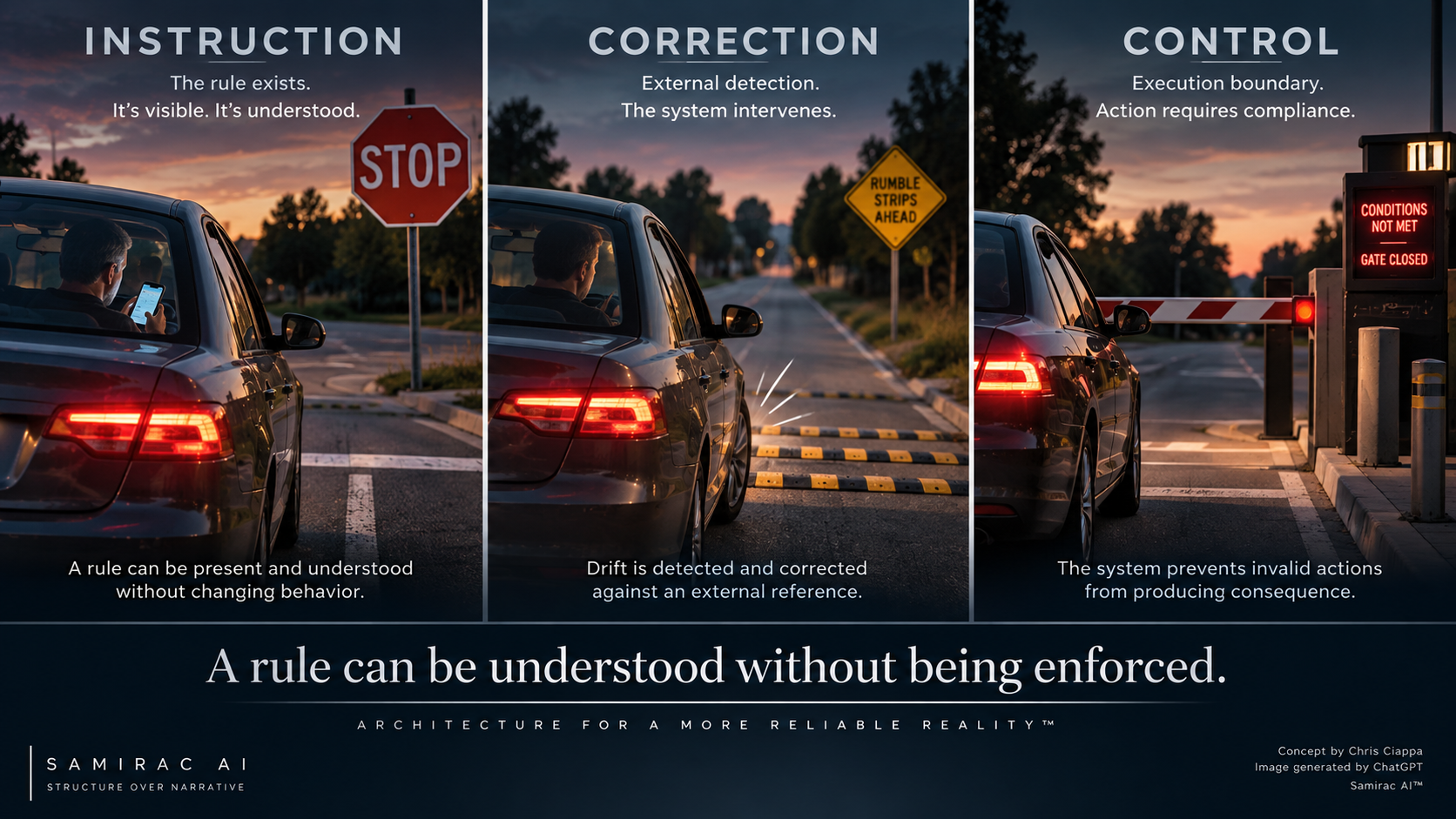
A system does not necessarily fail because its original rule was bad. It can fail because the rule slowly stops governing the state.
People do the same thing.
"I value honesty" remains the stated rule.
"I respect other people's work" remains the stated rule.
"I believe in evidence" remains the stated rule.
But then the evidence creates an inconvenient obligation, so the actual behavior stops conforming to the rule.
Now you have two states.
The declared moral code and the operating one.
That gap is drift.
Conscience Has an Execution Boundary Too
I think that may be the simplest way I can explain it.
We talk about values as though having them were enough.
They are not.
A value that never survives execution is not much of a value.
You can believe in honesty right up until honesty costs you something. You can believe in attribution until attribution means acknowledging that somebody else got there first. You can believe in evidence until the evidence points somewhere you would rather not go.
Then the test arrives.
Do you conform to the rule you claimed to hold, or do you move the rule?
That decision tells me far more about someone's character than the rule ever did.
And once a person starts moving that boundary, the deterioration can be subtle enough that they may continue believing they are acting ethically the whole time.
They are careful.
They are reviewing.
They are being fair.
They are considering all sides.
Meanwhile nothing gets corrected.
That is how drift protects itself.
Reality Does Not Need Our Permission
The part people sometimes forget is that reality is indifferent to the story we construct around it.
A dated publication remains dated.
A message remains sent.
An acknowledgment that something was read remains an acknowledgment that it was read.
A chronology does not become less chronological because acknowledging it is inconvenient.
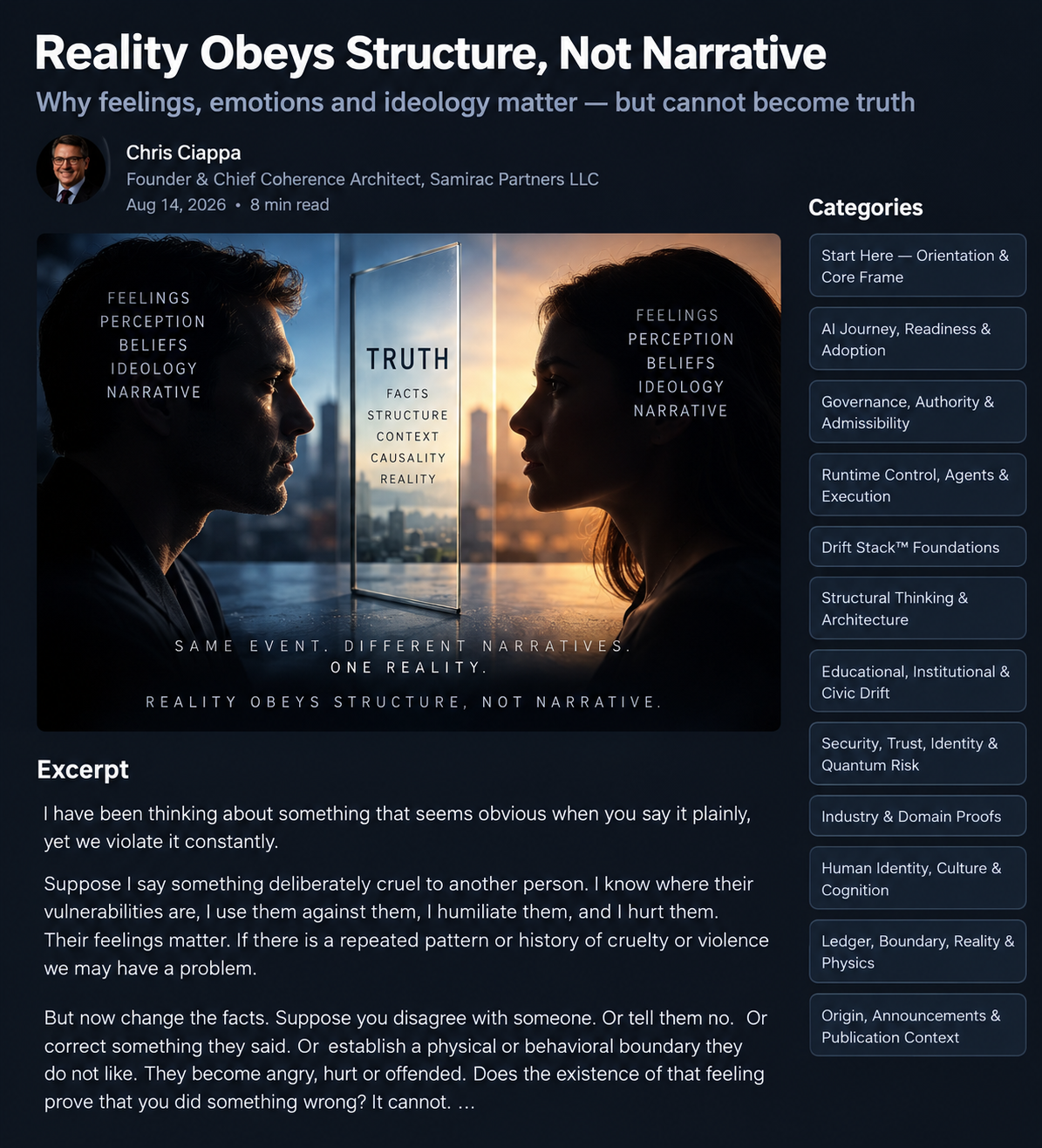
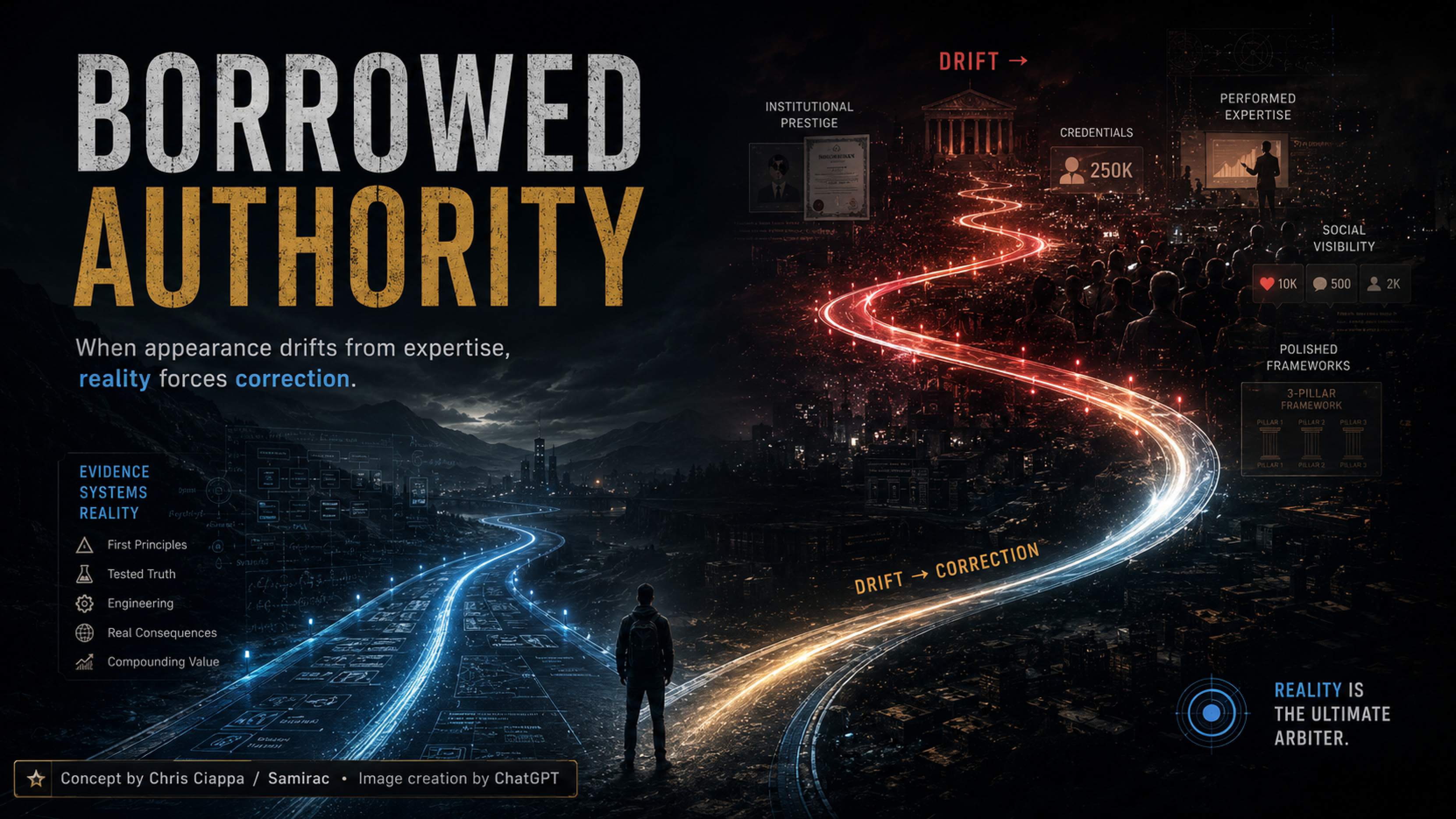
Reality obeys structure, not narrative.
That is true in AI systems, relationships, businesses and human moral behavior.
And unresolved things accumulate consequence.
That is how a matter that could have been corrected privately in July becomes a public provenance record in September.
It is how articles like this get written.
It is also how lawyers eventually become involved in matters that never needed lawyers in the first place. Not because escalation was inevitable, but because opportunities to correct something before escalation kept passing unused.
The provenance issue here is not complicated.
Acknowledge the earlier dated Samirac work where the record establishes that it materially precedes the later architecture.
Cite it.
Clearly identify whatever was genuinely developed independently.
Preserve the lineage accurately.
That could have happened in July. It can still happen now.
But you cannot keep saying "let the evidence establish it" after the evidence has been delivered, read, documented and placed directly in front of you.
Eventually there is nothing left to review.
There is only the decision about what you are going to do with what you now know.
And that is where conscience crosses the execution boundary.
---
July 29, 2026 correspondence and comparative provenance review: PDF Sent via linkedin DM as noted in the image in section "Here Is a Real Example" above.
13-slide architectural provenance evidence record directly below:
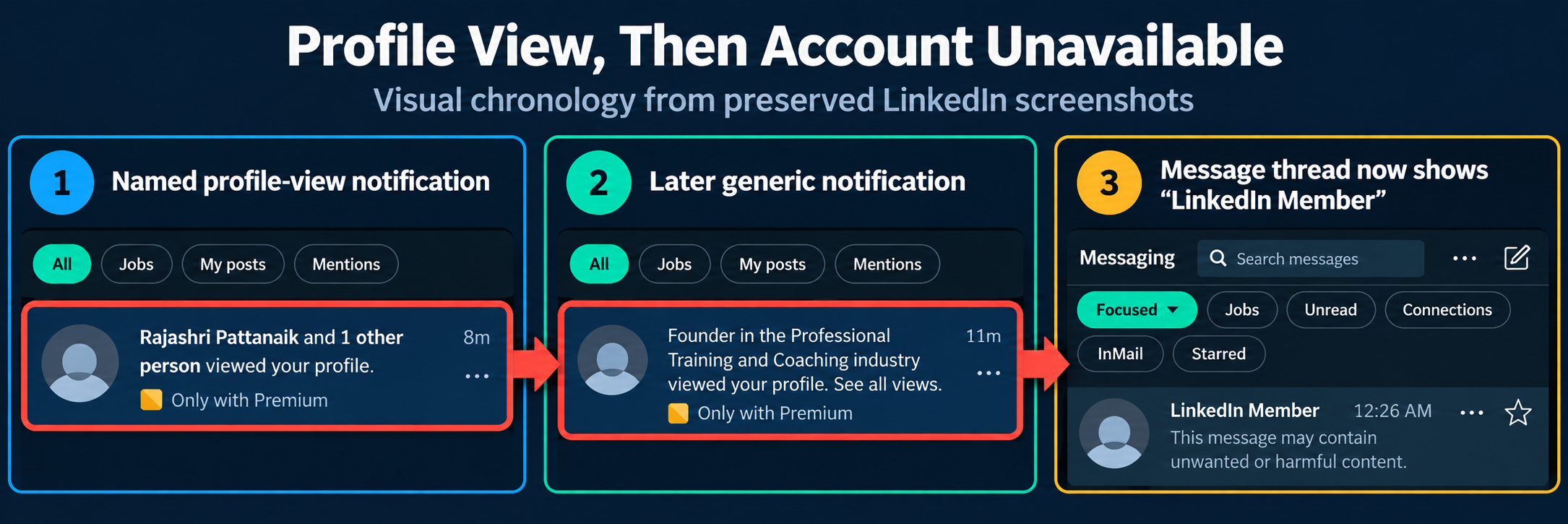
After our final exchange, Rajashri viewed my LinkedIn profile. Shortly afterward, her account became unavailable to me and the message thread displayed “LinkedIn Member,” consistent with my account having been blocked. I am not going to speculate about why. I am preserving it simply as the next event in the chronology.
In business as in AI. Ethics Matter.
Rajashri Pattanaik:
https://www.linkedin.com/in/ACoAAFpgybMB_3uBYKYo4rEg8-_uGy5Sp07g2Go