Reality Doesn't Care What You Believe
⠀
Have you ever wondered whether you're one of those people who can actually adapt when the world around you changes? Or are you one of the many who will cling to what they've always believed, even when reality is telling them something entirely different?
⠀
Think about that for a moment.
⠀
Throughout the history of life on Earth, entire species have come and gone. Environments changed, conditions changed, and those that couldn't adapt eventually disappeared. It wasn't necessarily the biggest, strongest, or most intelligent that survived. It was those whose characteristics allowed them to survive and reproduce under the conditions they faced.
⠀
Now, I realize we're not talking about biological evolution in quite the same way when we discuss human thinking, but there's an important relationship here.
⠀
What happens when the environment changes, but your understanding of that environment doesn't?
⠀
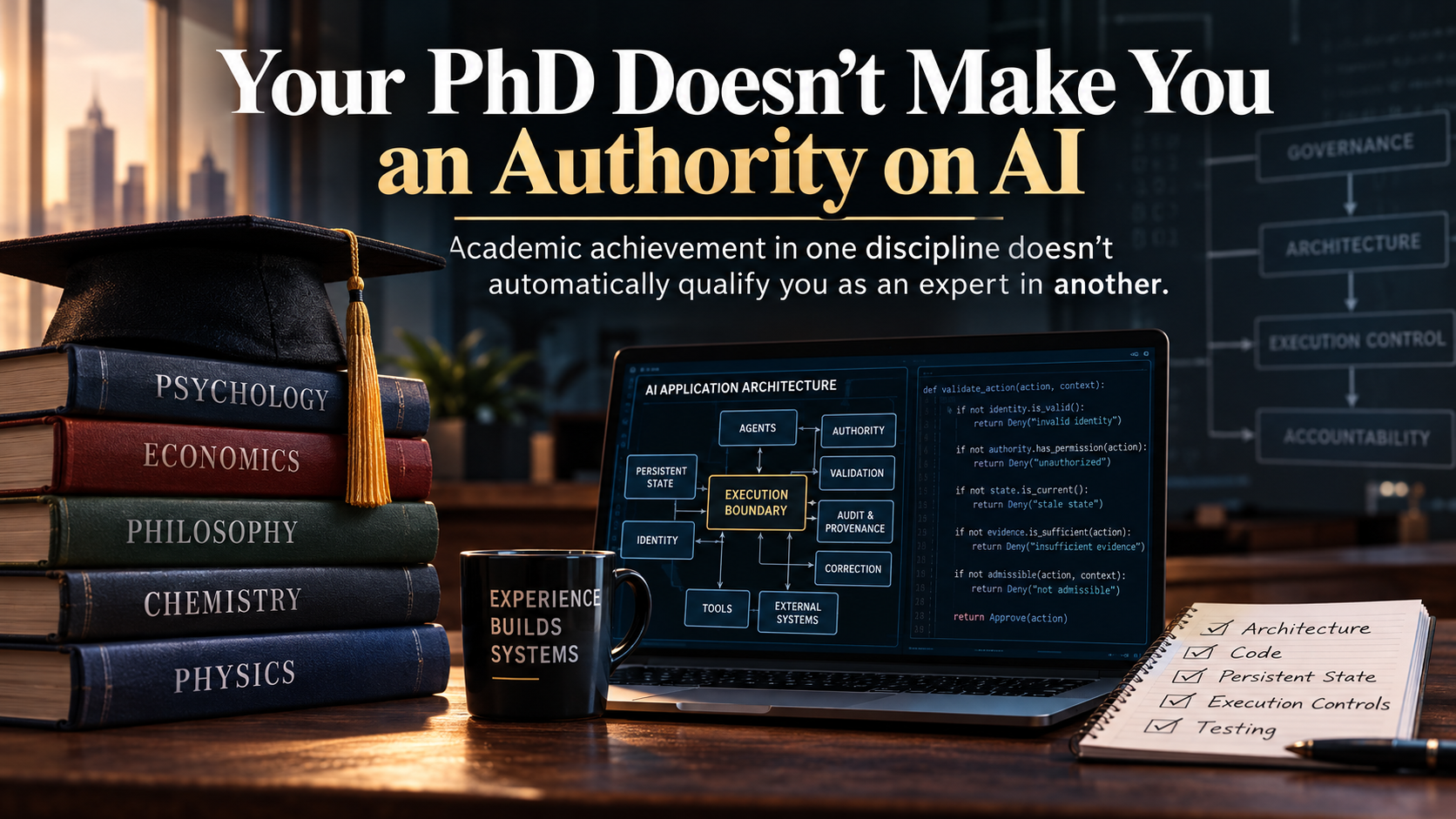
You can be the smartest person in the room, have more degrees than a thermometer, and hold the highest position of authority imaginable. But if you're making decisions based on an understanding of reality that is no longer accurate, how much good is all that intelligence or education doing you?
⠀
And perhaps more importantly, what happens to everybody else who trusts you?
⠀
Do You Seek Truth, or Do You Seek Confirmation?
⠀
I have always found it fascinating how people develop beliefs and then spend enormous amounts of energy defending them.
⠀
Someone hears something from a trusted source, perhaps a professor, a government agency, a religious leader, a television personality, or somebody with an impressive title. They accept it as true, and before long, that information becomes part of how they understand the world.
⠀
But what happens when new evidence comes along that contradicts it?
⠀
Do they examine the evidence? Do they reconsider what they believe? Or do they immediately start searching for reasons the new information must be wrong?
⠀
I think a lot of people confuse defending their beliefs with defending the truth, and those are two entirely different things.
⠀
If you're genuinely interested in truth, you have to be willing to discover that something you believed yesterday was wrong.
⠀
And that doesn't mean you're foolish for having believed it. It means you've learned something.
⠀
The foolishness begins when you refuse to learn.
⠀
Reality Is Not Determined by Authority
⠀
Here's something else I think we need to talk about, particularly in a world where people are constantly bombarded with information.
⠀
Who said something is not the same as whether what they said is true.
⠀
We have developed this extraordinary dependence on credentials, titles, institutions, and positions of authority as substitutes for evaluating information ourselves.
⠀
Now, don't misunderstand me. Education and experience are valuable. Expertise matters. Someone who has spent thirty years studying a particular subject probably knows a great deal more about it than someone encountering it for the first time.
⠀
But that doesn't make the expert infallible.
⠀
And it certainly doesn't mean the person without the credentials is incapable of recognizing something the expert missed.
⠀
History is full of examples of accepted ideas that were eventually overturned because someone questioned the prevailing explanation.
⠀
So why do we continue treating authority as though it determines reality?
⠀
Suppose five organizations publish conclusions about the same event. Four agree and one disagrees. Does that mean the four are correct?
⠀
Well, not necessarily.
⠀
What if those four organizations are all relying on the same original source? What if that source has repeatedly made inaccurate predictions? What if the fifth organization has independently gathered evidence and has a much better history of accurately predicting outcomes?
⠀
Suddenly, counting how many authorities agree doesn't tell us very much.
⠀
We need to understand where the information came from, how it was obtained, whether the sources are independent, how reliable they've been historically, and what evidence actually supports their conclusions.
⠀
And yes, we also need to consider whether the people and institutions presenting that information have interests or incentives that might influence what they're telling us.
⠀
That doesn't automatically make them wrong. It means we have more work to do.
⠀
Reality doesn't care about your credentials.
⠀
Truth Is Not a Popularity Contest
⠀
Think about how frequently the accepted explanation of something changes.
⠀
A government agency takes one position, and later takes another. Scientific understanding advances. New evidence becomes available. Investigations uncover information that wasn't previously known.
⠀
Sometimes the conclusions change because the evidence changed. Other times, the evidence may be largely the same, but the people interpreting it have changed.
⠀
Those are very different situations.
⠀
And here's what troubles me. How many people actually examine why the conclusion changed? How many simply accept the new explanation because it came from an institution they trust?
⠀
Consider the arguments surrounding COVID.
⠀
People spent years arguing about where the virus originated, what authorities knew, and which explanations deserved serious investigation. A possible laboratory origin was treated dismissively in much of the early public discussion, yet major American intelligence agencies later assessed it as a plausible or more likely explanation, with varying levels of confidence.
⠀
I'm not interested in relitigating every COVID argument here. What interests me is how people responded to the changing evidence and the changing positions of the institutions they trusted.
⠀
Did they examine what had changed? Did they question why certain explanations had been dismissed? Did they consider whether their earlier confidence had been justified?
⠀
Or did they simply wait for someone in authority to tell them what they were allowed to believe next?
⠀
That's the problem.
⠀
If your understanding of reality changes only when your preferred authority changes its position, are you actually evaluating reality?
⠀
Or are you just following somebody else?
⠀
The Difference Between Recognizing a Pattern and Proving It
⠀
There's something about human intelligence that I think deserves much more attention, and that's our ability to recognize patterns.
⠀
I have spent much of my life working across different industries, technologies, and disciplines. One thing I've learned is that seemingly unrelated things often share remarkably similar underlying structures.
⠀
You begin recognizing relationships between things that other people may not immediately connect.
⠀
And sometimes you recognize a pattern before you can fully explain why you recognize it.
⠀
For instance, you might notice that several people exhibit similar combinations of behaviors, reactions, or ways of thinking. Over time, you encounter those same patterns again and begin recognizing that they may be associated with certain characteristics or psychological conditions.
⠀
Does that mean you've proven anything with absolute certainty?
⠀
Of course not.
⠀
But if the pattern has repeatedly helped you make accurate predictions, wouldn't it be reasonable to investigate it?
⠀
That's how intuition can develop into testable knowledge rather than remaining an impression.
⠀
You observe something, recognize a relationship, form a possible explanation, and then compare that explanation against what actually happens.
⠀
And you keep doing it.
⠀
You also pay attention to the times your prediction fails, because those failures may tell you just as much as the successes.
⠀
What I find frustrating is when someone dismisses an observation simply because it hasn't already been formally established by a recognized authority.
⠀
How do they suppose discoveries happen in the first place?
⠀
Someone notices something that doesn't quite fit the accepted explanation and starts asking questions.
⠀
The observation doesn't become worthless simply because the explanation hasn't been proven yet.
⠀
We Live in a World of Probability
⠀
I don't believe we need absolute certainty to make reasonable judgments about reality.
⠀
In fact, very little of what we believe about the world comes with a guarantee that it can never be challenged by new evidence.
⠀
We operate with different degrees of confidence.
⠀
Some explanations are supported by enormous amounts of evidence. Others have very little support. And there are plenty of situations in between where we have to make the best judgment we can with the information available.
⠀
The important thing is understanding why we believe one explanation is more probable than another.
⠀
And that means looking at the totality of the evidence, not simply choosing the source we happen to like.
⠀
If someone has repeatedly made accurate predictions, that history matters. If they've repeatedly been wrong, that matters too. But neither history guarantees that their next claim will be correct or incorrect.
⠀
We still have to examine the evidence.
⠀
We also have to consider whether the information is genuinely independent, whether we're overlooking contradictory evidence, and whether the relationships we're observing actually support the conclusion we've reached.
⠀
That's what objective reasoning should look like.
⠀
Not pretending every possible explanation is equally likely simply because none has been proven with absolute certainty.
⠀
And certainly not treating the prevailing institutional position as the final word.
⠀
You make the best judgment the evidence supports, recognize how confident you should be in that judgment, and remain willing to change it when reality demands it.
⠀
When Authority Becomes a Source of Misinformation
⠀
There's another consequence to all this that I think people overlook.
⠀
Misinformation doesn't necessarily require dishonesty.
⠀
A person can sincerely believe they're telling the truth while spreading information that is wrong.
⠀
And when someone uses their degree, certificate, professional title, or institutional position as a substitute for examining the evidence, they may contribute to misinformation without ever intending to deceive anyone.
⠀
In some ways, that can be especially dangerous.
⠀
Think about it. Someone makes a statement, and thousands of people believe it because of the authority attached to their name. Those people repeat it to others, who repeat it again, until eventually the claim becomes something everybody supposedly knows.
⠀
But where was the evidence?
⠀
Did anybody actually examine it?
⠀
Or did we simply build an enormous network of people repeating something because they trusted the person who said it first?
⠀
The number of people repeating a claim doesn't make it true. Nor does the reputation of the person who originated it.
⠀
And if that person turns out to have been wrong, how many others are prepared to reconsider what they've accepted?
⠀
This is why I believe intellectual honesty carries an enormous responsibility, particularly for those whose positions influence the decisions of others.
⠀
If you cannot explain the evidence and reasoning behind your conclusions, your title is not an adequate substitute.
⠀
Are You Actually Capable of Adapting?
⠀
Now we get back to the question I started with.
⠀
Throughout history, survival has depended on how organisms interact with their environments. Some possess characteristics that allow them to thrive under changing conditions, while others do not.
⠀
Human beings have an extraordinary advantage. We can learn, reason, communicate, recognize patterns, and deliberately change our behavior.
⠀
We don't necessarily have to wait for generations of biological evolution to respond to a changing environment.
⠀
But what good is that ability if we refuse to use it?
⠀
What happens when people become so attached to what they've been taught that they can no longer recognize evidence that contradicts it?
⠀
What happens when societies begin treating questions as threats, disagreement as disloyalty, and institutional authority as a substitute for objective examination?
⠀
I think those are questions worth asking, because the consequences extend far beyond any one individual.
⠀
Our beliefs influence our decisions. Our decisions influence our actions. And our collective actions influence the world we create.
⠀
If those beliefs are increasingly disconnected from reality, what should we expect the consequences to be?
⠀
One Question Worth Asking Yourself
⠀
I'd like you to think about something.
⠀
Can you name an important belief you once held that you changed because the evidence convinced you it was wrong?
⠀
Not because someone with a bigger title told you to change it. Not because it became socially fashionable to believe something else. And not because everyone around you suddenly started saying something different.
⠀
Because you examined the evidence yourself and realized that your previous understanding no longer made sense.
⠀
If you can, good. That's an important part of learning.
⠀
But if you can't, I'd encourage you to ask yourself why.
⠀
Are you genuinely seeking truth, or have you spent much of your life defending what you already believe?
⠀
I don't expect to be right about everything. Nobody should. There may be something I learn tomorrow that changes my understanding of something I've believed for decades.
⠀
And if the evidence supports that change, I want to know.
⠀
Because the most adaptable person isn't necessarily the one who knows the most. It's the one who can recognize when what they think they know no longer matches reality—and change accordingly.
⠀
And that brings me to something else I've spent a great deal of time thinking about.
⠀
And One More Question: Is Your AI Built to Adapt?
⠀
We've talked about people recognizing patterns, evaluating evidence, questioning authority, and changing their understanding when reality demands it.
⠀
But what about the artificial intelligence systems we're increasingly depending upon?
⠀
Are they capable of doing the same thing?
⠀
Think about it. We build these extraordinary language models, train them on enormous amounts of information, and then expect them to help us reason, make decisions, and increasingly take actions on our behalf.
⠀
But what happens when the information they learned is outdated, the environment changes, or new evidence contradicts something the model previously accepted as true?
⠀
Does the AI recognize that something has changed? Does it remember what happened before, compare that history against what's happening now, and adjust its conclusions accordingly?
⠀
Or does it simply produce another confident answer based on whatever information happens to be available at that moment?
⠀
And here's something I think is particularly important.
⠀
This isn't solely the responsibility of the companies building the language models.
⠀
The developers building AI agents and systems around those models have a responsibility, too.
⠀
An AI system can maintain historical context, track its own operating state, evaluate new evidence, recognize contradictions, measure the reliability of its predictions, and determine whether its previous assumptions remain valid.
⠀
It can also distinguish between recognizing that something may have changed and deciding whether it's appropriate to act on that information.
⠀
Those capabilities don't necessarily require retraining the underlying language model every time something changes. They require building systems that can observe, evaluate, remember, and adapt over time.
⠀
And if we're going to give AI increasingly important responsibilities, shouldn't we expect exactly that?
⠀
I find it remarkable that we spend so much time discussing how intelligent these models are, while comparatively little attention is given to whether the complete systems surrounding them can recognize when their understanding of reality has drifted away from what's actually happening.
⠀
After all, what good is an intelligent system that cannot recognize when its own understanding is wrong?
⠀
This Is Why We Built the SAMIRAC Architecture
⠀
This is not simply a theoretical question for me. It's one of the architectural problems we've been working to address through SAMIRAC and dAIsy.
⠀
Instead of assuming the language model must somehow handle everything itself, we've been developing a system architecture that accounts for what happens around the model and over time.
⠀
What was the state of the system when a decision was first considered? What has changed since then? Has new evidence emerged? Are the assumptions behind a previous decision still valid? Has the system drifted away from the conditions under which an action was originally considered acceptable?
⠀
And perhaps most importantly, does the system still have sufficient grounds and authority to act right now?
⠀
That last question matters.
⠀
A model might generate a perfectly reasonable recommendation based on information it received five minutes ago. But what if something important changed during those five minutes?
⠀
Perhaps the evidence changed. Perhaps the operating conditions changed. Perhaps an authorization was withdrawn, or the action is no longer appropriate under the current circumstances.
⠀
Should the system proceed simply because the model previously recommended it?
⠀
I don't think so.
⠀
The SAMIRAC architecture is designed to address these problems by separating model-generated reasoning from the controls that determine whether an action is admissible at the moment of execution.
⠀
That includes maintaining and evaluating relevant state, recognizing drift, considering external evidence and correction, and enforcing the conditions under which the system is permitted to act.
⠀
There's a distinction here that I think is essential.
⠀
Recognizing that reality has changed is not the same thing as being authorized to act on that change.
⠀
An AI system should be able to update its understanding without automatically gaining permission to do something it wasn't previously allowed to do.
⠀
That's why adaptation and execution control need to be considered together, while remaining distinct responsibilities.
⠀
And none of this requires us to wait for the next generation of language models to solve the problem for us.
⠀
These are architectural responsibilities that developers can address in the systems they build around those models.
⠀
The underlying model can remain extraordinarily useful for language, reasoning, and recognizing relationships, while the surrounding architecture maintains the state, evidence, constraints, and execution controls necessary to operate responsibly in a changing environment.
⠀
That's the direction we've been pursuing.
⠀
Reality Obeys Structure, Not Narrative
When I look at all of this together, I see the same underlying problem appearing in two very different places.
Human beings develop beliefs about reality. AI models develop representations of reality from the information available to them.
Both can be wrong.
Both can encounter new information that contradicts what they previously understood.
And both can continue producing confident conclusions long after the conditions supporting those conclusions have changed.
The difference is that with AI systems, we have an opportunity to deliberately engineer mechanisms that recognize and respond to those changes.
We can build systems that preserve relevant history, test assumptions against new evidence, recognize when conditions have changed, and control whether an action remains permissible.
But we should also be willing to ask whether we, as human beings, apply anything resembling that same discipline to our own thinking.
Do we examine our assumptions? Do we remember which explanations actually predicted reality accurately? Do we recognize when our understanding has drifted away from the evidence?
Or do we simply defend yesterday's conclusions because changing our minds would be uncomfortable?
I don't think intelligence, whether human or artificial, should be measured solely by how much information it possesses or how confidently it can produce an answer.
We should also care about its ability to recognize when its understanding is wrong, evaluate what has changed, and respond appropriately.
Because ultimately, the question isn't simply whether you're intelligent enough to understand the world.
It's whether you're adaptable enough to recognize when your understanding of the world is wrong—and do something about it.
Reality doesn't care what you believe, how educated you are, who you know, what position you hold, or how sophisticated your AI model happens to be.
It simply is.
Reality obeys structure, not narrative.
And whether we're talking about human beings or the intelligent systems we're creating, we all have to deal with the consequences.