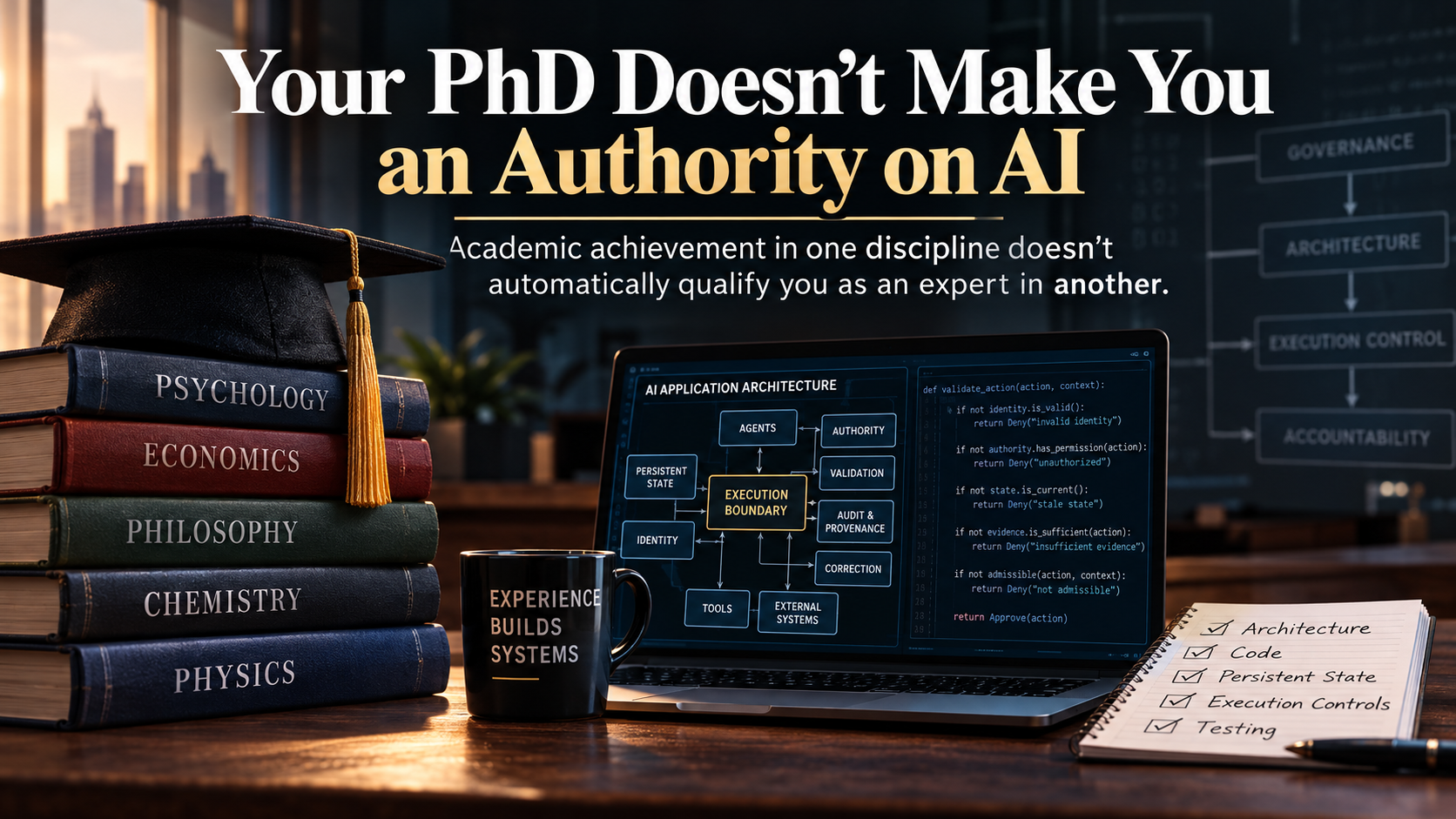
I've been noticing something on LinkedIn lately that I find increasingly irritating, particularly in discussions surrounding artificial intelligence.
There seems to be an endless parade of people with PhDs in everything imaginable, offering authoritative opinions about what AI systems can and cannot do, how they should be architected, what constitutes agency, whether systems can learn, and how autonomous systems should be governed.
And I keep wondering how many of these people have actually designed or built a functioning AI system.
Not used ChatGPT. Not experimented with prompts or read a few research papers.
I'm talking about designing the underlying application architecture, writing code, managing persistent state, dealing with distributed systems, building execution controls, and understanding what actually happens when software moves beyond producing an answer and begins taking consequential actions.
Because those are very different things.
Don't misunderstand me. I have tremendous respect for people who earn doctorates. It takes years of work, considerable discipline, and a serious commitment to mastering a particular subject.
But that's precisely the point. A particular subject.
If you have a PhD in psychology, economics, philosophy, chemistry, or any other discipline, congratulations. You've demonstrated advanced knowledge in that field. But where, exactly, did that qualify you to become an authority on software engineering, enterprise architecture, autonomous agents, or the operational behavior of complex information systems?
It didn't.
And somehow, that fairly obvious distinction seems to have gotten lost in the excitement surrounding AI.
Knowing About AI Isn't the Same as Knowing How to Build It
Think about it this way.
Suppose I introduce you to a brilliant physicist who's spent twenty years researching quantum mechanics. He's published papers, taught graduate students, and earned recognition from his peers.
Now I tell you I'd like him to design the transaction-processing architecture for a major financial institution.
Would you assume he's qualified because he understands advanced mathematics and complicated technical concepts?
Of course not. You'd want to know whether he understands database transactions, distributed systems, security, operational state, failure recovery, and the engineering disciplines involved in building such a system.
His doctorate doesn't magically provide that knowledge.
Yet I see people making remarkably confident pronouncements about AI architectures they've never examined, often without demonstrating any experience designing comparable systems themselves.
And when somebody challenges their conclusions, rather than examining the architecture being discussed, they cite another researcher, introduce another theory, or begin debating terminology.
Well, that's interesting, but it doesn't establish whether the system works.
It establishes that you can discuss the subject.
There's a considerable difference.
Even AI Expertise Has Boundaries
This problem isn't limited to doctorates in unrelated fields, either.
Someone can be an extraordinarily accomplished machine learning researcher and still have limited experience designing production enterprise systems.
Understanding model training, probability distributions, neural networks, and transformer architectures is valuable expertise. But a model is only one component of a larger application.
Once you introduce persistent memory, identity, operational state, external tools, relationships, delegated authority, execution boundaries, and correction mechanisms, you're dealing with systems architecture.
Those components don't disappear because the person examining the system happens to specialize in model research.
And you cannot reasonably declare what the entire system can or cannot accomplish by examining only the model and ignoring the architecture surrounding it.
I've encountered this repeatedly in discussions about whether AI agents can learn or adapt.
Someone points out that the underlying model's weights haven't changed and concludes that the agent hasn't learned anything. Meanwhile, the application may have reconstructed its state, corrected an earlier error, updated a relationship, modified its behavior, and preserved those changes for subsequent interactions.
You can certainly debate what constitutes learning. But before dismissing the system's capabilities, shouldn't you at least understand how the system operates?
That's the part I find so extraordinary.
People will confidently tell you what an architecture cannot do without having read the architecture, examined its components, or understood the engineering principles involved.
And their credentials are somehow supposed to make that conclusion authoritative.
Expertise Has to Be Relevant
I've spent decades working with information systems, databases, software, business intelligence, and enterprise technology. That experience has given me a foundation for the architectural work I've developed around AI.
But I wouldn't walk into a conversation about molecular biology, announce that I understand complex systems, and start correcting a researcher who's spent twenty years studying cellular mechanisms.
I'd recognize that the person has specialized knowledge I don't possess.
Why should we expect anything less from people commenting on AI?
If your academic background doesn't include software engineering, systems architecture, coding, or the relevant technical disciplines, then perhaps your first responsibility is to recognize what you don't know.
That doesn't mean you can't participate in the discussion. You absolutely can. AI affects nearly every discipline, and contributions from those disciplines can be enormously valuable.
But participating in a discussion and claiming technical authority over an architecture are two entirely different things.
And there's nothing wrong with asking somebody to explain how their system works before deciding whether you agree with them.
In fact, I would think that's exactly what an educated person ought to do.
A Credential Is Not a Substitute for Competence
What concerns me most is how easily we've begun confusing academic titles with technical authority.
Somebody has a doctorate, publishes frequently about AI, develops a following, and before long they're presenting themselves as an expert on everything from neural networks to enterprise governance and autonomous system design.
But where is the relevant engineering experience?
What systems have they designed?
What have they implemented, tested, or demonstrated that establishes competence in the particular area they're commenting on?
Those aren't unreasonable questions when someone claims authority over a technical discipline.
And this has consequences beyond LinkedIn arguments.
Organizations are making decisions about AI architecture, security, governance, and autonomous execution based on advice from people whose qualifications may have very little relationship to the systems they're being asked to evaluate.
A polished presentation, wasted tokens on pretty moving images, and an impressive academic biography don't establish that someone understands how an enterprise system behaves when authority changes, operational state becomes invalid, or an autonomous agent attempts to execute something it shouldn't.
Those are architectural and engineering problems, and they deserve to be addressed by people who actually understand them.
I'm not suggesting that practical experience automatically makes someone correct, either. Anyone can make a bad architectural decision, myself included. That's why we document our work, examine the mechanisms, and test the claims.
But at least we're evaluating the thing that matters rather than the credentials of the person making the argument.
I've never believed intelligence and education were the same thing, and I certainly don't believe an advanced degree grants someone universal authority over every technical subject they choose to discuss.
A PhD deserves respect for the discipline in which it was earned.
That's an accomplishment worth recognizing.
But if you're going to make authoritative claims about AI systems, particularly architectures you haven't studied and technologies you haven't demonstrated the ability to engineer, your academic title isn't enough.
And perhaps before telling somebody what their system cannot do, you ought to take the time to understand what they've actually built.
Because having a doctorate doesn't mean you understand AI architecture any more than having a pilot's license makes you an aeronautical engineer.
Expertise doesn't transfer simply because the subject is fashionable. You still have to know what you're talking about.
Chris Ciappa
Founder & Chief Coherence Architect
Samirac Partners LLC
https://samirac.com