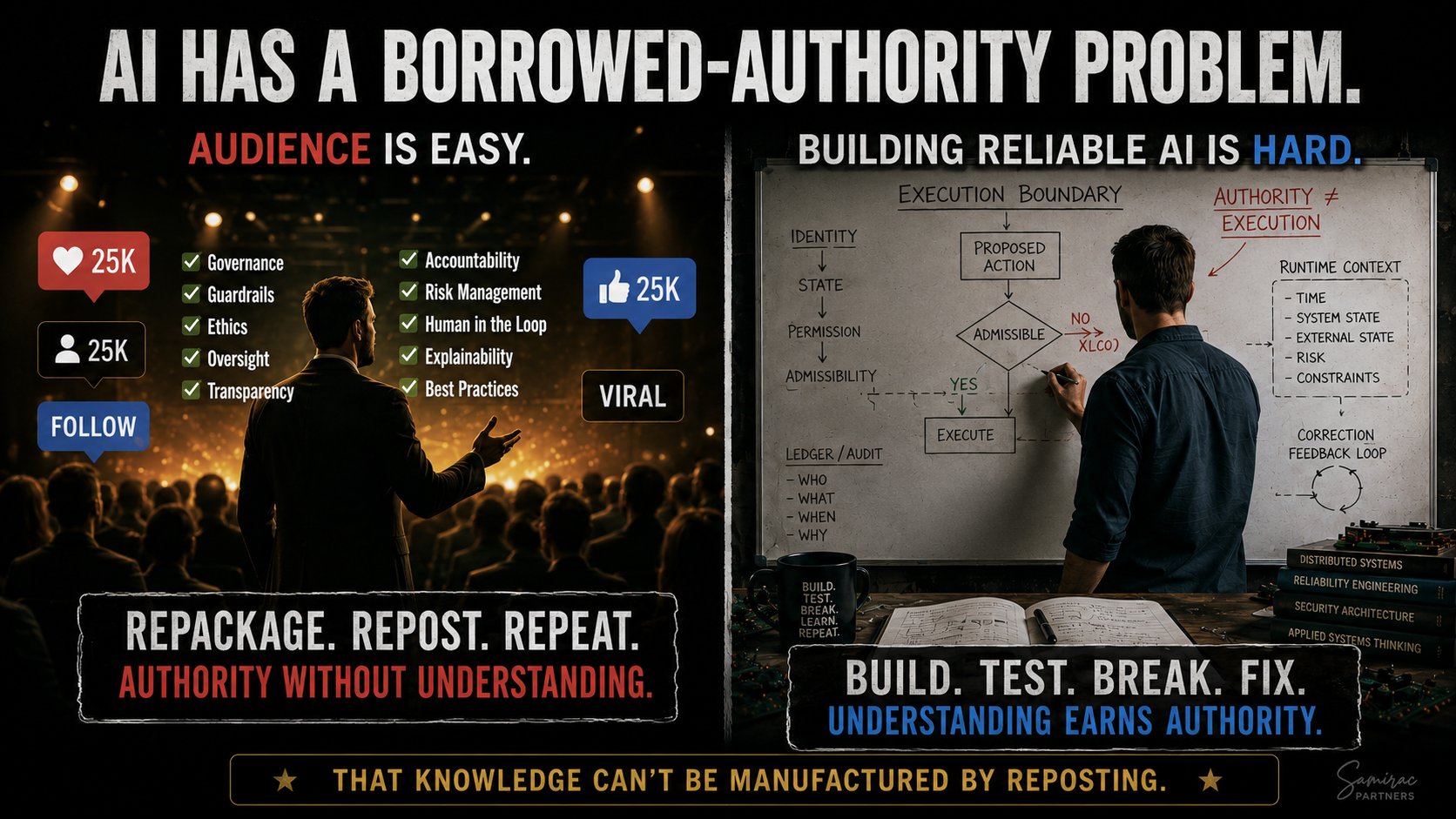
I have been thinking about this borrowed-authority problem for a while now, and the more I look at it the more I think AI is getting blamed for something it did not actually create.
AI accelerated it. AI scaled it. AI made it ridiculously easy.
But we built the conditions for it long before ChatGPT showed up.
A lot of it goes all the way back to how we educate people.
For generations we have increasingly taught students to succeed by finding the answer the institution wants, reproducing it in the form the institution recognizes, and then moving on to the next subject. Do that well enough for long enough and eventually you receive a credential telling the rest of society that you know something.
There is obviously nothing inherently wrong with education or credentials. I am not suggesting we hand somebody a scalpel because they are a great independent thinker and tell them to have at it. There are bodies of knowledge people actually have to learn.
The problem starts when the credential becomes a substitute for demonstrating whether somebody can actually reason with what they learned.
Can they take the knowledge out of the classroom and apply it when the problem does not look like the textbook? Can they recognize when two accepted answers from two different disciplines conflict with each other? Can they explain why something works, where it stops working, what assumptions it depends on, and what happens when those assumptions change?
That is a very different kind of learning.
I wrote recently about why an eighth-grade Amish education can sometimes produce more functional competence than years of modern institutional schooling. The point was never that algebra or chemistry somehow became unnecessary. It was that learning does not stop when the classroom stops. You learn by working, building, repairing, running a business, solving problems and living with the consequences of getting something wrong.
Reality grades the test.
If you wire something incorrectly, it does not care how confident you were. If you price a job badly, you lose money. If the crop does not grow, you cannot explain to the field that you followed the approved framework.
That feedback loop develops a different kind of mind.
Modern institutions, unfortunately, can insulate people from that loop for a very long time. Knowledge gets divided into specialties. Success becomes increasingly dependent on navigating the institution itself. The person learns the language, the process, the accepted theories, the people whose approval matters and the kinds of answers that move them forward.
Then we send those people into organizations that are structured almost exactly the same way.
Finance has its language. Technology has its language. Legal has its language. Compliance has its language. Operations has its language. Marketing has its language. Everybody can become extremely competent inside a vertical slice of the organization while almost nobody is required to understand the structure that connects all of those slices together.
That matters because the real world is not organized into departments.
A technical decision can create a regulatory problem, which creates an operational constraint, which changes the economics, which changes the risk, which changes what the system should be allowed to do.
Structural thinkers naturally move across those relationships. They are constantly comparing what they are seeing in one domain against what they know in another. Something may sound perfectly reasonable inside one discipline and still make absolutely no sense when you test it against the rest of the system.
Narrative thinkers operate differently. They can become extraordinarily good at explaining the accepted story inside the frame they have been given. They know the language, the authorities, the frameworks and the arguments that belong there.
For a long time organizations could absorb a lot of that because there were layers and layers of people underneath leadership translating those narratives into something that could actually operate.
Then social media arrived and changed the incentives again.
It created an entirely new market for the appearance of expertise.
Before LinkedIn, newsletters, podcasts and the rest of the professional influencer economy became what they are today, professional reputation usually accumulated fairly slowly. People knew what you had built, where you had worked, what problems you had solved and whether other people trusted you to solve another one.
Now there is another path.
You can accumulate followers.
That sounds harmless until you think about what the platforms actually reward.
They do not know whether your architecture works. They cannot tell whether you have ever operated the thing you are explaining. They do not know whether the framework in your carousel survives contact with a production environment.
They know whether people clicked.
So naturally the system begins selecting for the people who can produce the most convincing representation of expertise, frequently and consistently enough to keep the audience engaged.
That is not the same skill as actually possessing the expertise.
In fact, the incentives can work against each other.
Real expertise is slow.
You have to spend years learning something. Then you build it. You discover that half of what you believed was wrong. You rebuild it. Something breaks in a way you never anticipated. You stare at it for two days wondering what idiot designed this thing, eventually remember that the idiot was you, and then you fix it.
Over time you begin to understand not merely what works, but why it works and where it fails.
There is no shortcut for that.
Content creation has exactly the opposite economics. The more frequently you publish, the more chances you have to be seen. The more confidently you simplify something, the easier it is for a broad audience to consume. Attach the right institutional name, cite the framework everybody is discussing this week, add ten bullets and a professionally designed graphic, and suddenly you look remarkably authoritative.
Then AI arrived.
Now we have removed the production bottleneck almost completely.
Someone can encounter an idea Monday morning, have an AI summarize it by lunch, turn it into a framework Monday afternoon, generate a diagram Tuesday, publish a newsletter Wednesday and be explaining the idea to thousands of people by Thursday.
That person may be intelligent. They may even understand parts of what they are saying.
But there is something fundamentally different between understanding the description of a system and having lived through the process of building one.
AI makes that difference harder to see because the language is no longer a useful signal.
That may be one of the strangest changes happening around us right now.
You used to have to become something before you could reliably sound like it.
Now you can sound like something long before you have become it.
And once the audience gets large enough, the audience itself begins creating authority. People assume the person must know what they are talking about because 50,000 other people appear to think so.
The authority becomes circular.
The followers validate the expertise and the presumed expertise attracts more followers.
Add a prestigious university, consulting firm, conference badge or executive title and the effect gets stronger. None of those things are meaningless. They become a problem when we stop treating them as evidence to consider and start treating them as proof.
I see this constantly now in AI governance.
Someone completes a governance program at Harvard, Stanford, MIT or some other prestigious institution and comes out speaking fluently about responsible AI, fairness, stakeholders, explainability, policies, ethical red lines and governance frameworks.
Fine.
Now connect an AI system to something that can actually alter the world.
Let it approve a transaction, modify a database record, send money, change infrastructure, issue an order, control a machine or act through another system.
Suddenly the conversation changes.
A policy does not physically stop the action. A governance committee is not sitting inside the execution path. The university certificate does not determine whether the authority under which the agent is operating still exists thirty seconds after it was granted.
Somebody has to architect that.
The system has to know whose authority is being exercised, what that authority permits, what state the world is currently in, whether the assumptions under which the decision was made still hold and whether the action remains admissible before it is allowed to execute.
That is where the difference between knowing the language and understanding the system becomes impossible to hide.
It is also why I have become increasingly skeptical of institutional prestige being used as an authority symbol in technical conversations. Harvard can teach a governance framework. Stanford can publish an AI ethics program. MIT can issue another certificate. None of that changes what the system has to do when it reaches the execution boundary.
Reality does not recognize the logo.
And this is much larger than AI governance.
We have built an entire professional culture that increasingly rewards recognition before demonstration.
People want the title. They want the followers. They want the conference invitation. They want the little cape that says influencer, thought leader, AI expert, strategist, chief whatever.
Again, there is nothing wrong with building an audience. I publish constantly. I want people to read my work too.
The question is what the audience is being asked to trust.
Are you showing people something you understand because you have worked through it, or are you building authority by continuously repackaging whatever is currently receiving attention?
There is a difference between curation and creation, between explaining somebody else’s work and presenting yourself as the authority behind it, and between having an opinion about architecture and having actually had to make architecture survive.
The internet is increasingly collapsing those differences.
AI is accelerating that collapse because it can manufacture nearly all of the outward signals we historically associated with expertise. It can generate the articulate explanation, the diagram, the polished framework, the executive summary, the confident answer and the sophisticated vocabulary.
What it cannot manufacture after the fact is provenance.
It cannot go backward and give you the years in which you built the system. It cannot create repository history that did not exist, demos that were never run, failures you never experienced, architectural decisions you never made or a documented progression showing how an idea developed before it became fashionable.
That is why provenance is becoming more important, not less.
When the appearance of expertise becomes cheap, the history behind the expertise becomes valuable.
I want to know when the work appeared, how it developed, whether something was actually built, whether it can be demonstrated and whether the person can explain where it fails. I want to understand what evidence supports the claim and, maybe more importantly, what evidence would prove the claim wrong.
That is not an unreasonable burden. That is how serious disciplines are supposed to work.
And no, it does not mean everyone has to publish their proprietary source code or give away private intellectual property simply because they make a public statement.
But if you publicly position yourself as an authority, criticize the work of others and make broad claims about the superiority of your own approach, eventually somebody is entitled to ask what can actually be inspected.
You cannot demand evidence from everyone else and then declare your own authority exempt from evidence because your methodology is private.
That is not expertise.
That is trust theater.
The reason I think this is becoming so important now is that the consequences are changing.
When somebody posts a bad marketing framework, the world probably survives.
When somebody who has learned to perform architectural competence is given authority over systems that can move money, alter infrastructure, make decisions or take autonomous action, borrowed authority stops being irritating and starts becoming dangerous.
Because reality does not care how many followers somebody has, where the certificate came from, how many frameworks they can name or how convincing the LinkedIn post looked. Once the system is operating, the consequences are physical and economic. The transaction executes, the database changes, the agent acts, the aircraft stalls and the balance sheet absorbs the loss.
Reality remains the final authority.
That is why I do not think the answer to manufactured expertise is another credential or another institutional badge. We have plenty of those already.
The answer is to restore the relationship between authority and evidence.
If somebody claims operational expertise, there should be something underneath the claim. Maybe it is a body of work, an architecture, a working system, a history of implementations, measurable results, dated research, demonstrations, failures that produced corrections or a theory stated clearly enough that somebody else can actually test it.
Usually it is some combination of those things.
Most importantly, the person should be able to articulate the mechanism well enough that another intelligent person can follow the reasoning rather than simply being asked to accept the conclusion.
That is what structural thinking ultimately demands.
Not that everybody agree.
Not that institutions disappear.
Not that expertise stop existing.
Quite the opposite.
It demands that expertise once again earn its authority by demonstrating a durable relationship with reality.
AI did not create the borrowed-authority problem.
We spent decades building a culture in which credentials, institutional affiliation, titles, language and visibility increasingly stood in for demonstrated understanding.
Social media monetized it.
The influencer economy rewarded it.
And AI finally made the performance scalable.
Now we have to relearn how to tell the difference.
---
Christopher S. Ciappa
Founder & Chief Coherence Architect
Samirac Partners LLC
Samirac develops architecture, assessment, and execution-control systems for consequential AI, including Drift Stack™, SAQ™, DeltaDrift™, AI RADAR™, and dAIsy.
Related Reading:
Who Remains In The Wake of AI?
https://synth.samirac.com/article/who-remains-in-the-wake-of-ai
When Leadership Lacks Architectural Competency, Systems Fail
https://synth.samirac.com/article/when-leadership-lacks-architectural
AI Lifecycle Maturity Model™
https://samirac.com/article/ai-lifecycle-maturity-model
AI RADAR™ — AI Readiness & Deployment Assessment
https://www.samirac.com/ai-radar
Assessment
Enterprise AI Architecture Reference
https://www.samirac.com/architecture-reference
Original Work & Architectural Provenance