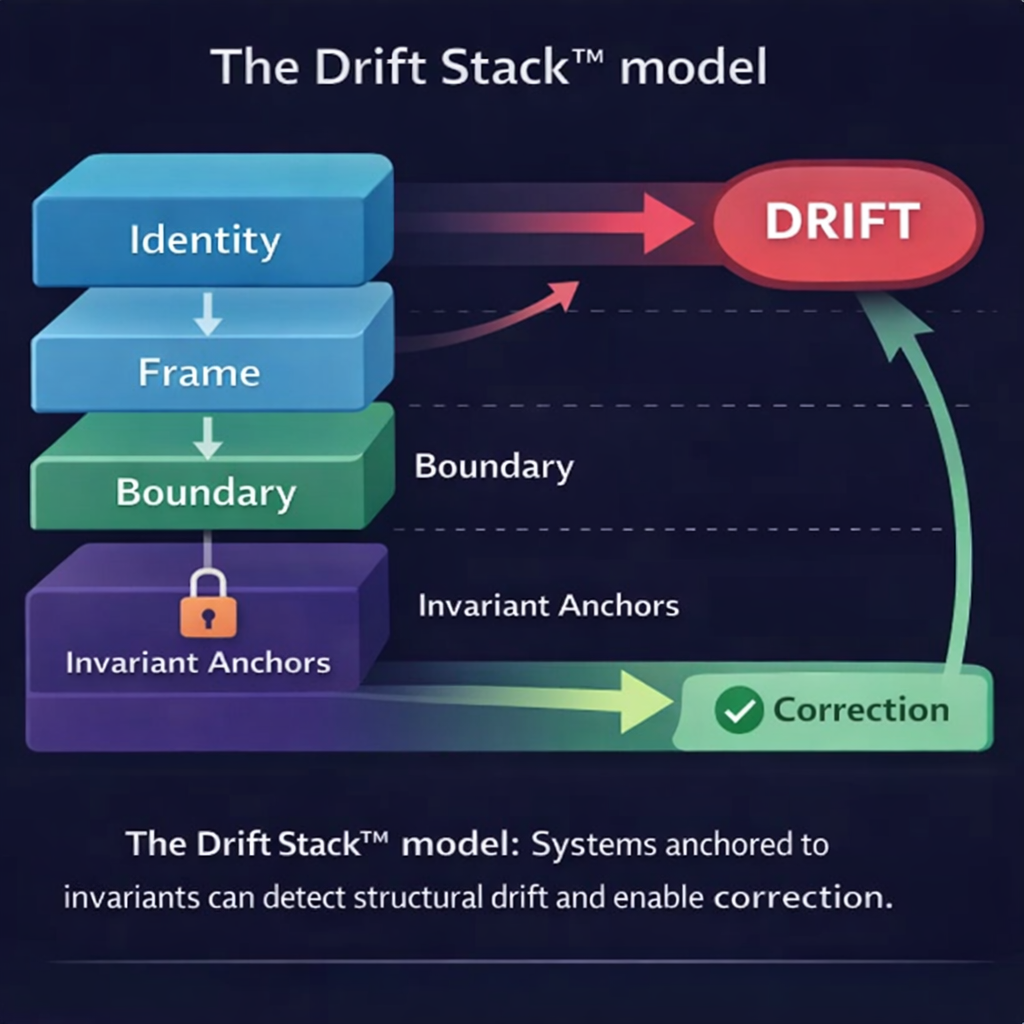
\The Drift Stack™ was originally developed to study how complex systems gradually move away from their stated objectives.
Most systems don’t fail suddenly.
They drift.
Policies drift.
Organizations drift.
Institutions drift.
Over time the system begins operating differently than the structure it was originally designed to uphold.
The Drift Stack models this process by anchoring systems to measurable invariants and detecting deviations from those anchors.
This framework at inception was for security, AI governance, and institutional risk analysis.
Recently it became clear the same architecture could be applied to a domain where structural measurement is almost nonexistent:
civic education.
Across the United States there is constant debate about what schools are or are not teaching in civics and government courses.
But almost all of these debates operate without measurable structure.
There is no national system that evaluates whether institutions remain aligned with the foundational civic knowledge that underpins the functioning of a constitutional republic.
This led to the concept of a platform called the Civic Curriculum Integrity Index (CCII).
The CCII would not evaluate ideology or political viewpoints.
Instead it would measure structural alignment with civic education invariants.
In other words:
Are the foundational structural elements of civic governance actually being taught?
The system would produce a measurable Civic Curriculum Integrity score derived from structured signals such as:
• topic coverage
• instructional commitment
• document exposure
• institutional literacy indicators
Over time, aggregated data could create the first national dataset measuring civic knowledge transmission.
The Drift Stack architecture would allow the platform to detect institutional drift — cases where education systems gradually move away from foundational civic structures.
The long-term vision is a transparent measurement platform that could potentially serve:
• state education systems
• civic organizations
• research institutions
• governance bodies
But this idea requires something first.
It requires builders.
Technical Partner Opportunity
I am looking for a serious full-stack developer/s or technical founders interested in participating as founding partners in building the CCII platform.
This is not a contract job.
This is a build-and-license opportunity.
Technical partners would:
• participate in building the platform architecture
• earn Drift Architect certification during development
• potentially license and deploy the platform to institutions
The goal is to assemble a small group of systems builders capable of turning the concept into a real operational platform.
If you read this and immediately begin thinking about:
“How would I architect this system?”
Then you are exactly the type of person I want to talk to.
Apply
If you’re interested in participating as a technical partner, there is a short application below.
The goal of the application is simple:
identify builders.
Apply here:
CCII Partner Application
https://www.samirac.com/ccii-partner-application