By Chris Ciappa
Founder & Chief Coherence Architect
Samirac Partners
Built for systems that must survive reality
Built for systems that must survive reality.
By Chris Ciappa
Founder & Chief Coherence Architect
Samirac Partners
Most organizations don’t fail because they lack talent.
They fail because they lack a control point between decision and execution.
Below, I break down the structure that fixes that.
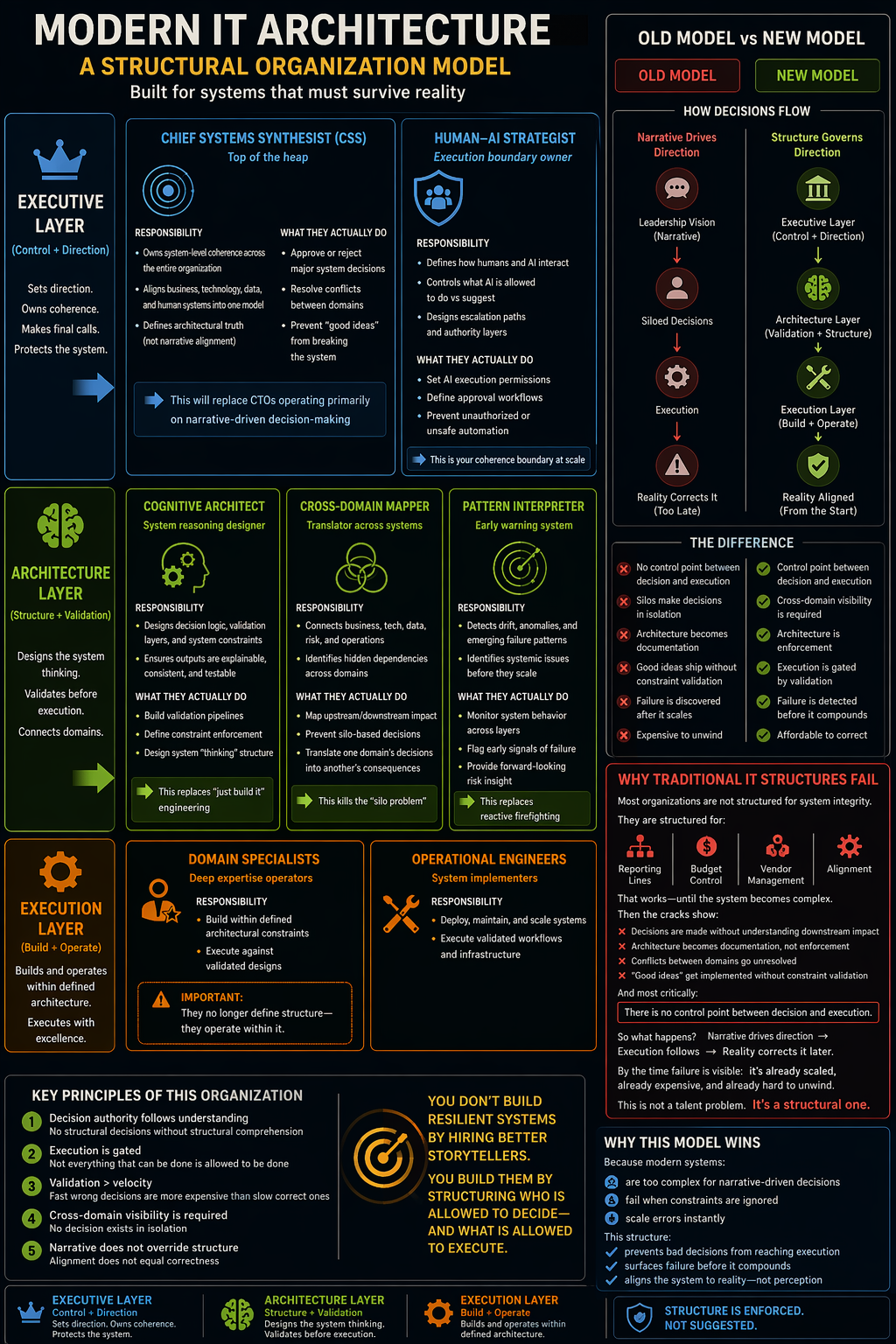
Top of the heap
Responsibility:
Owns system-level coherence across the entire organization
Aligns business, technology, data, and human systems into one model
Defines architectural truth (not narrative alignment)
What they actually do:
Approve or reject major system decisions
Resolve conflicts between domains
Prevent “good ideas” from breaking the system
👉 This will replace CTOs operating primarily on narrative-driven decision-making
Execution boundary owner
Responsibility:
Defines how humans and AI interact
Controls what AI is allowed to do vs suggest
Designs escalation paths and authority layers
What they actually do:
Set AI execution permissions
Define approval workflows
Prevent unauthorized or unsafe automation
👉 This is your coherence boundary at scale
System reasoning designer
Responsibility:
Designs decision logic, validation layers, and system constraints
Ensures outputs are explainable, consistent, and testable
What they actually do:
Build validation pipelines
Define constraint enforcement
Design system “thinking” structure
👉 This replaces “just build it” engineering
Translator across systems
Responsibility:
Connects business, tech, data, risk, and operations
Identifies hidden dependencies across domains
What they actually do:
Map upstream/downstream impact
Prevent silo-based decisions
Translate one domain’s decisions into another’s consequences
👉 This kills the “silo problem”
Early warning system
Responsibility:
Detects drift, anomalies, and emerging failure patterns
Identifies systemic issues before they scale
What they actually do:
Monitor system behavior across layers
Flag early signals of failure
Provide forward-looking risk insight
👉 This replaces reactive firefighting
Deep expertise operators
Responsibility:
Build within defined architectural constraints
Execute against validated designs
👉 Important:
They no longer define structure—they operate within it
System implementers
Responsibility:
Deploy, maintain, and scale systems
Execute validated workflows and infrastructure
Most organizations are not structured for system integrity.
They are structured for:
reporting lines
budget control
vendor management
and alignment
Then the cracks show:
Decisions are made without understanding downstream impact
Architecture becomes documentation, not enforcement
Conflicts between domains go unresolved
“Good ideas” get implemented without constraint validation
And most critically:
There is no control point between decision and execution.
So what happens?
Narrative drives direction
Execution follows
Reality corrects it later
By the time failure is visible:
it’s already scaled
already expensive
and already hard to unwind
Old model:
CTO (narrative-driven, vendor-led decisions)
CIO (alignment-focused, not system-aware)
Architecture as documentation (not enforcement)
👉 Structure is enforced, not suggested
No structural decisions without structural comprehension
Not everything that can be done is allowed to be done
Fast wrong decisions are more expensive than slow correct ones
No decision exists in isolation
Alignment does not equal correctness
Because modern systems:
are too complex for narrative-driven decisions
fail when constraints are ignored
scale errors instantly
This structure:
👉 prevents bad decisions from reaching execution
👉 surfaces failure before it compounds
👉 aligns the system to reality—not perception
You don’t build resilient systems by hiring better storytellers.
You build them by structuring who is allowed to decide—and what is allowed to execute.
Several related articles expand on the broader organizational, architectural, strategic, and cognitive themes discussed here:
Modern IT Architecture: A Structural Perspective
Explores why real architecture is fundamentally structural rather than purely procedural or technological.
When Leadership Lacks Architectural Thinking
Examines what happens when organizational leadership operates without structural systems cognition.
Looks at which forms of cognition and operational capability become more valuable as AI reshapes labor and knowledge work.
The AI Divergent Thinker: Why the Future May Belong to Structural Minds
Explores divergent cognition, systems-level thinking, and why structural minds may become increasingly important in the AI era.
The Ciappa Drift Stack: How My Divergent Thinking Led to Drift Architecture
Connects divergent cognition, architecture, drift theory, and the emergence of the Drift Stack framework.
Explains why organizations consistently underes
These pieces connect structural thinking, organizational drift, leadership cognition, execution behavior, systems architecture, and runtime operational coherence into a broader systems-level framework.
They make certain failures impossible to execute.
The architecture is already defined.
Drift Stack™ Architecture
https://www.samirac.com/drift-architecture
Now ask yourself:
👉 Does my system control what’s allowed at execution —
or does it just react and hope it gets it right?
Architecture Demos
https://www.samirac.com/daisy-demos
If you found this article valuable, share it.
Substack automatically gives every subscriber a personal referral link. When someone subscribes through your share link, it counts toward referral rewards.
Current rewards:
• 3 referrals → 1 month of paid access
• 5 referrals → 6 months of paid access
• 10 referrals → 12 months of paid access
You can share directly using the Share button on this article, or find your personal referral link here:
By Chris Ciappa
Founder & Chief Coherence Architect
Samirac Partners
Continue reading

People rarely abandon their moral code in one dramatic act. They move the boundary a little at a time, rationalize the next decision, and eventually defend a state they once would have recognized as wrong. This is ethical drift—and a current provenance dispute shows exactly what happens when documented facts are sitting in plain sight.
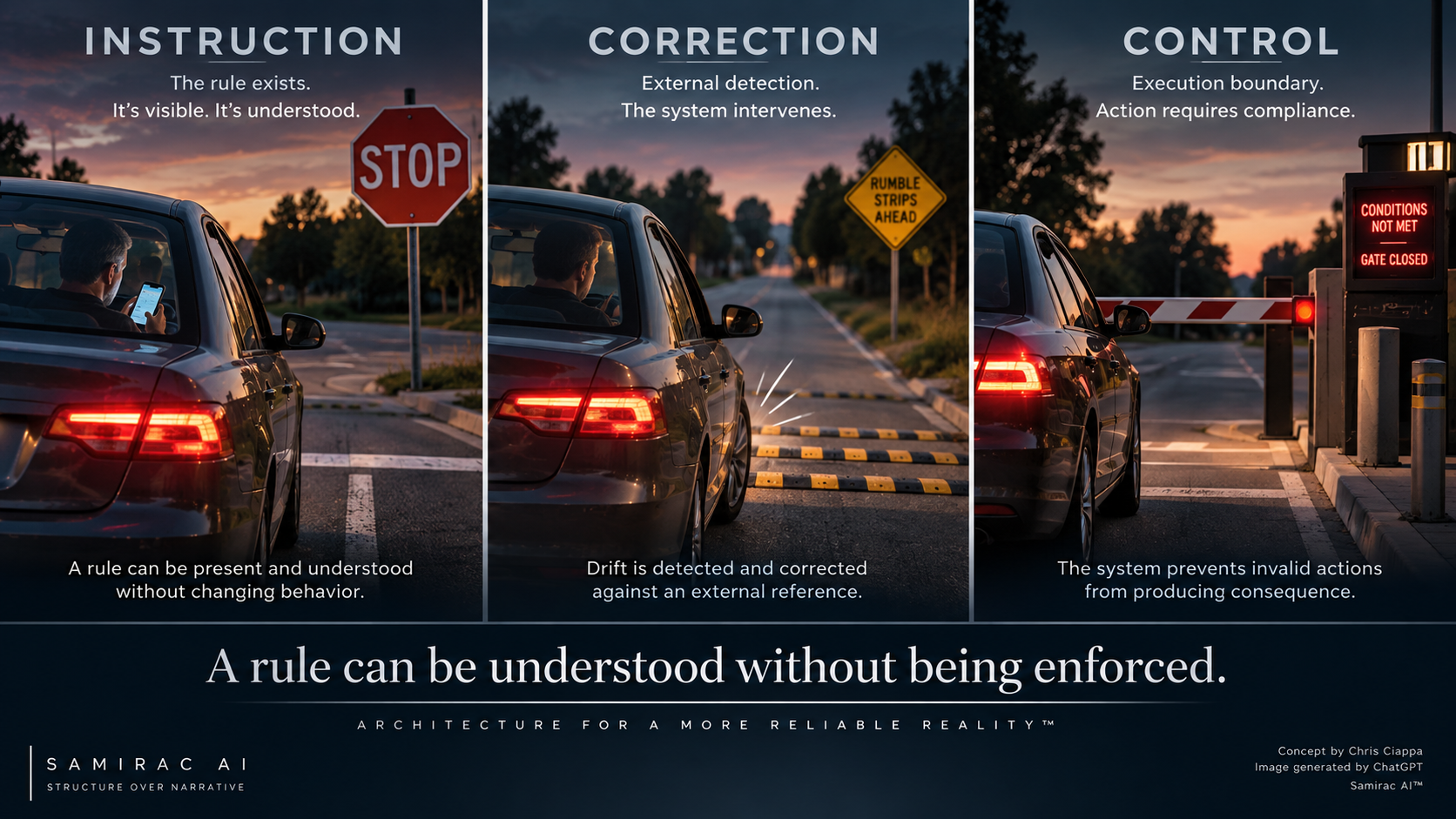
I gave ChatGPT an external specification for how I write. It understood it, had followed it before, and then ignored it anyway. What happened next became an unexpectedly clean demonstration of AI drift, external correction, and why having a rule is not the same thing as enforcing it at execution.

Feelings matter. Perception matters. Belief matters. But none of them becomes truth simply because it is sincerely or intensely held. Whether in relationships, ideology, or AI governance, the same category error appears when internal experience is allowed to substitute for external reality. Truth may be difficult to determine. That does not make it subjective. Reality obeys structure, not narrative.