AI Readiness Built From Architecture, Not Another Checklist
I did not set out to build another AI maturity survey.
There are plenty of those already.
Most can tell you whether an organization has policies, whether leadership supports AI, whether employees are experimenting with it, or whether somebody has established a governance committee.
Those are useful questions.
But they are not enough.
The problem changes as AI moves from producing an answer to influencing a decision, entering a workflow, and eventually taking an action.
At that point the question is no longer simply:
“Are we using AI?”
It becomes:
Where should we use it? Are we actually ready to operate it? Who owns the decision? What authority does the system have? What happens when circumstances change? And what prevents an action that is technically possible but should no longer be allowed?
That is what AI RADAR™ was built to examine.
And it is now running as a SaaS application, partner workspace, professional reporting system, and API platform.
[Take the AI RADAR Assessment]
[Explore Partner Access]
It Did Not Begin With 55 Questions
AI RADAR has 55 questions today.
But the questions came last.
The architecture came first.
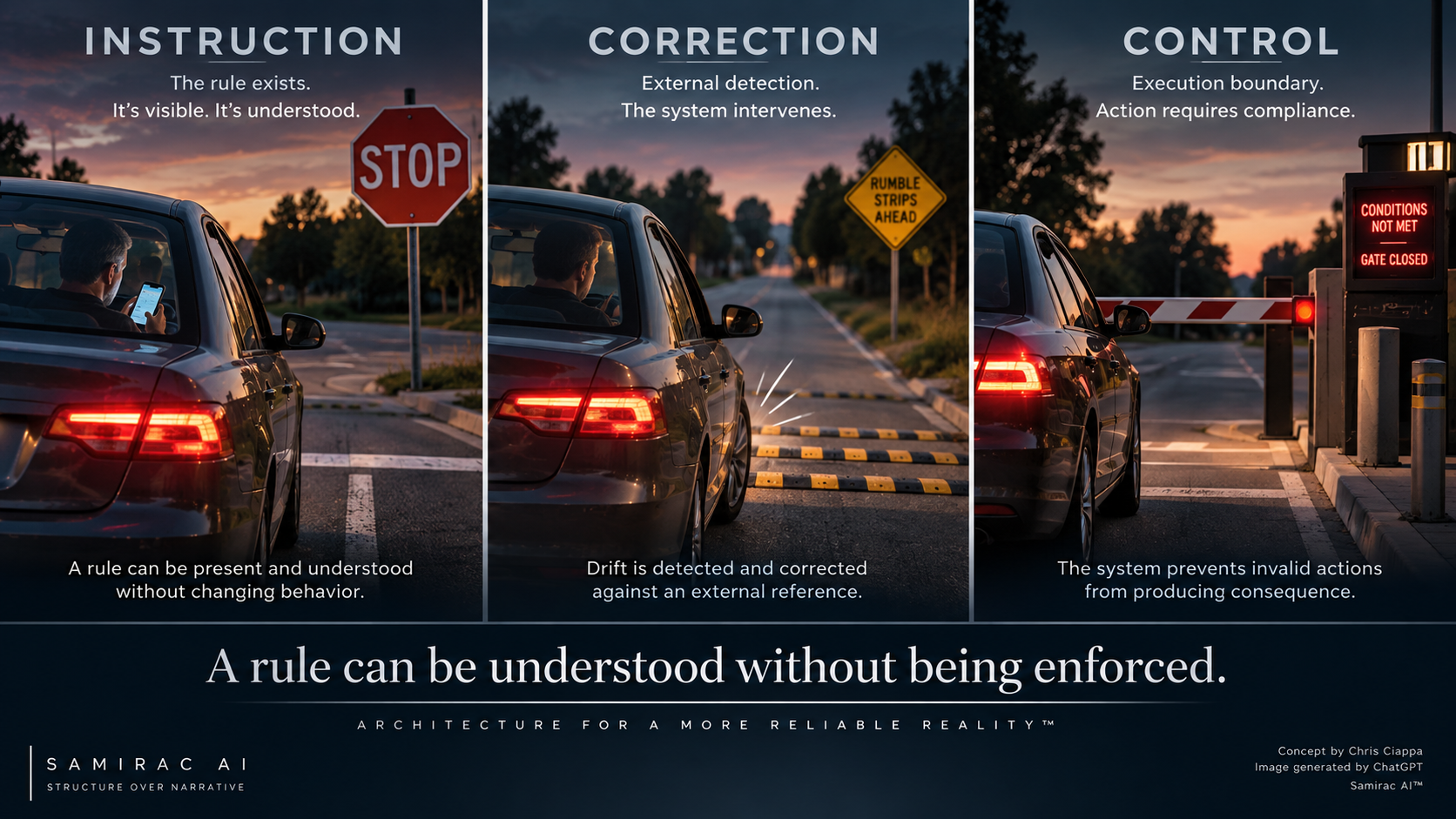
My work started from a proposition that is capable of being wrong.
As AI moves closer to consequential action, model intelligence alone is not enough to determine whether the resulting system is trustworthy.
Identity matters.
Current state matters.
Authority matters.
The boundary around execution matters.
Drift matters.
And the ability to detect and correct a changing condition matters.
If increasingly autonomous systems could operate safely and reliably without maintaining those things, then the architectural proposition would fail.
That makes it something more useful than a slogan about “responsible AI.” It gives us something we can examine in an actual system.
From that work came the Samirac AI Lifecycle Maturity Model™, the architectural work around authority and execution, and eventually AI RADAR.
The assessment is therefore not a collection of generic governance questions with a score attached afterward.
It is an attempt to determine where an organization actually stands against an operating architecture.
AI Readiness Is More Than Readiness
That sounds circular, but it matters.
An organization can have enthusiastic executives, good data, a capable technology team, and several successful pilots—and still be poorly prepared to expand AI.
Why?
Because those are only pieces of the operating environment.
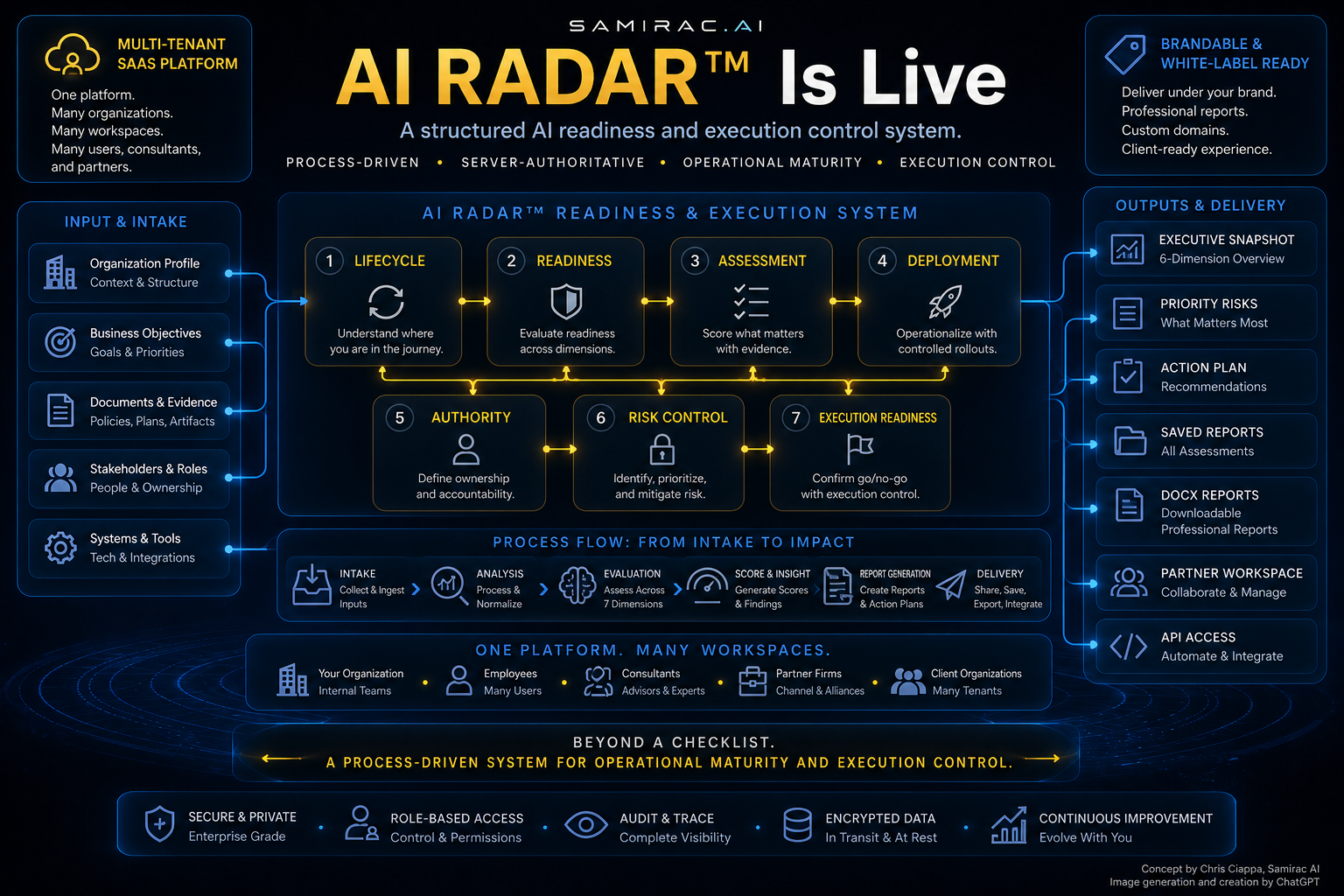
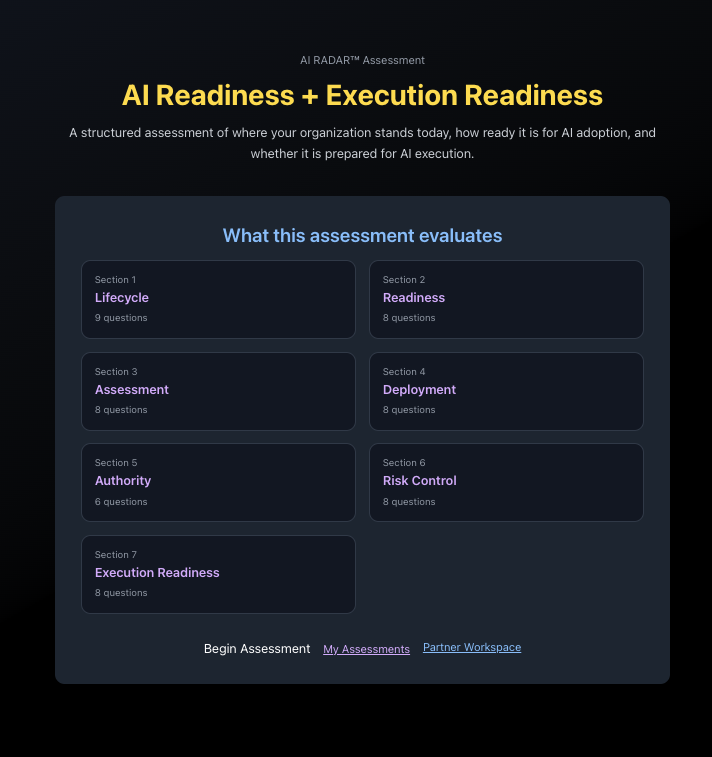
AI RADAR evaluates the organization across seven connected areas:
Lifecycle — where AI actually sits in the operating model today.
Readiness — business rationale, leadership alignment, funding, workforce, data and ownership.
Assessment — whether the organization is choosing the right problems and understanding the workflows and decisions before introducing AI.
Deployment — whether AI can move into real operations with support, monitoring, ownership and lifecycle discipline.
Authority — who owns decisions, what AI is permitted to do, how approval and accountability are established.
Risk Control — how risk is identified, prioritized, controlled, accepted and revisited.
Execution Readiness — whether authority and current conditions can actually be enforced as AI moves toward action.
Lifecycle positioning is evaluated separately, while the other six areas receive scored maturity results.
That matters because a company can be strong in one area and badly exposed in another.
A good deployment process does not compensate for weak authority.
A governance policy does not compensate for an execution boundary that cannot enforce it.
Good data does not mean the organization picked the right business problem.
And a technically functioning AI application does not mean the operating organization is ready to depend on it.
You Do Not Get a Score and a “Good Luck”
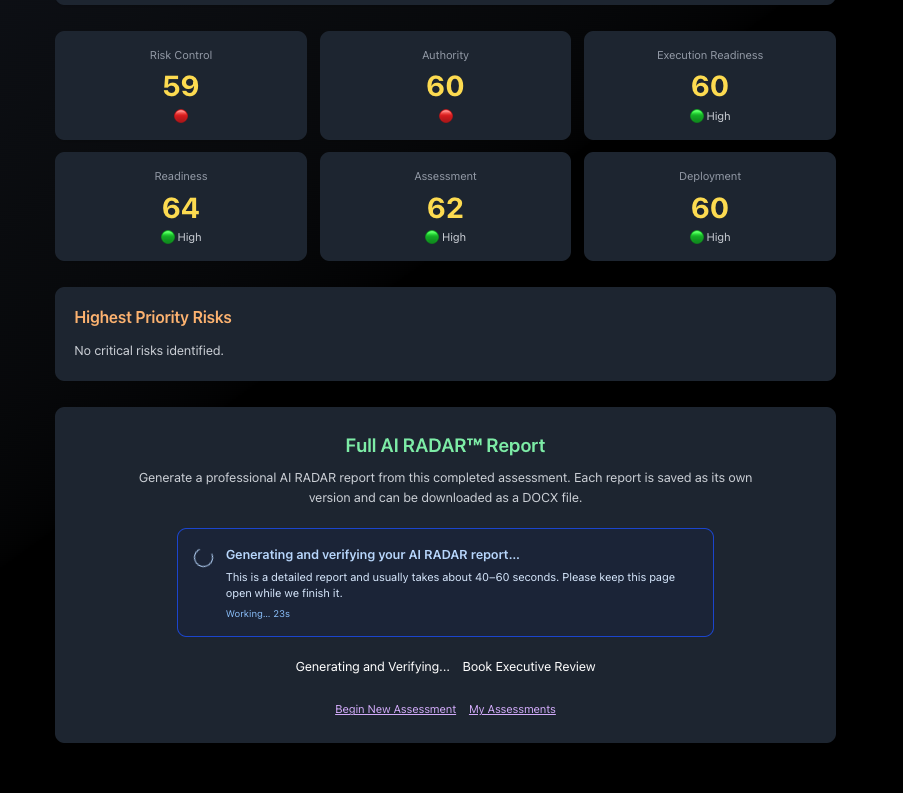
The Executive Snapshot gives you the immediate picture.
Lifecycle position.
Risk Control.
Authority.
Execution Readiness.
Readiness.
Assessment.
Deployment.
And the highest-priority risks identified from the assessment.
But that is only the beginning.
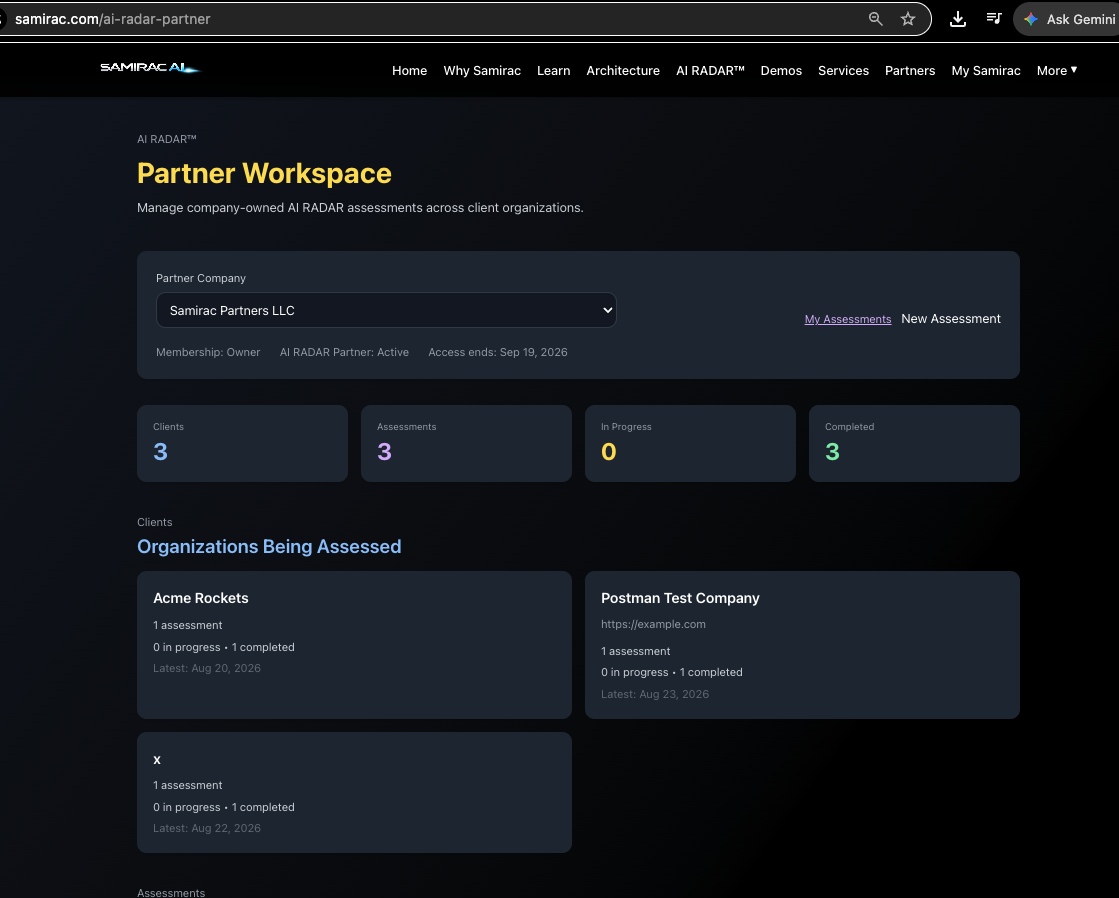
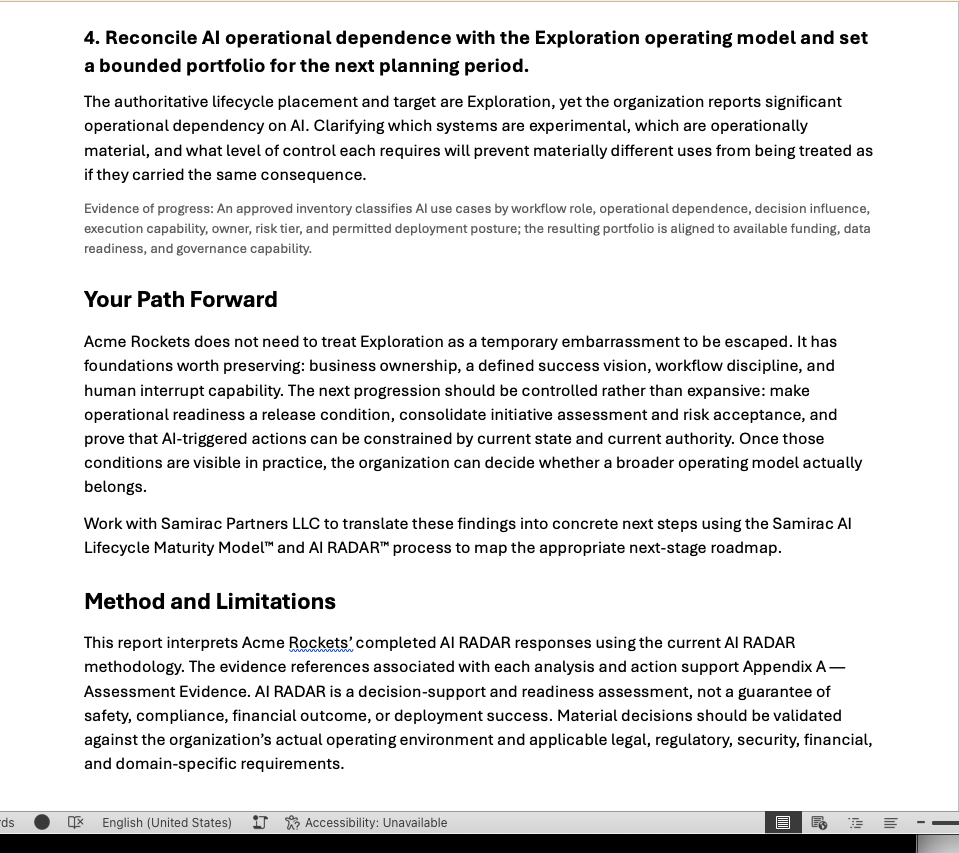
A completed AI RADAR assessment can generate a professional report that interprets the results against the organization’s actual answers.
That report explains what the scores mean, why the important findings matter, what conditions are constraining advancement, and what should happen next.
It then turns those findings into prioritized actions with concrete evidence of progress.
And because an assessment is evidence, not magic, the detailed responses are retained in an appendix rather than hidden behind an unexplained algorithm.
The result is something an executive, technology leader, risk officer, consultant, architect or board can actually discuss.
The report is generated, validated, saved as its own version, and delivered as a downloadable DOCX.
Generate another report later and the previous report is not silently overwritten.
That matters because AI RADAR itself will continue to evolve. Models improve. The Samirac body of work evolves. Reporting improves.
A report delivered to a customer should remain the report that was actually delivered.
AI RADAR Was Also Built for the People Who Help Companies Do This Work
There is another reason I did not want AI RADAR to end as a form on the Samirac website.
Consultants, integrators, AI advisory firms, technology partners and governance specialists are already helping organizations decide what to do with AI.
They need a way to establish the client’s actual position before prescribing the answer.
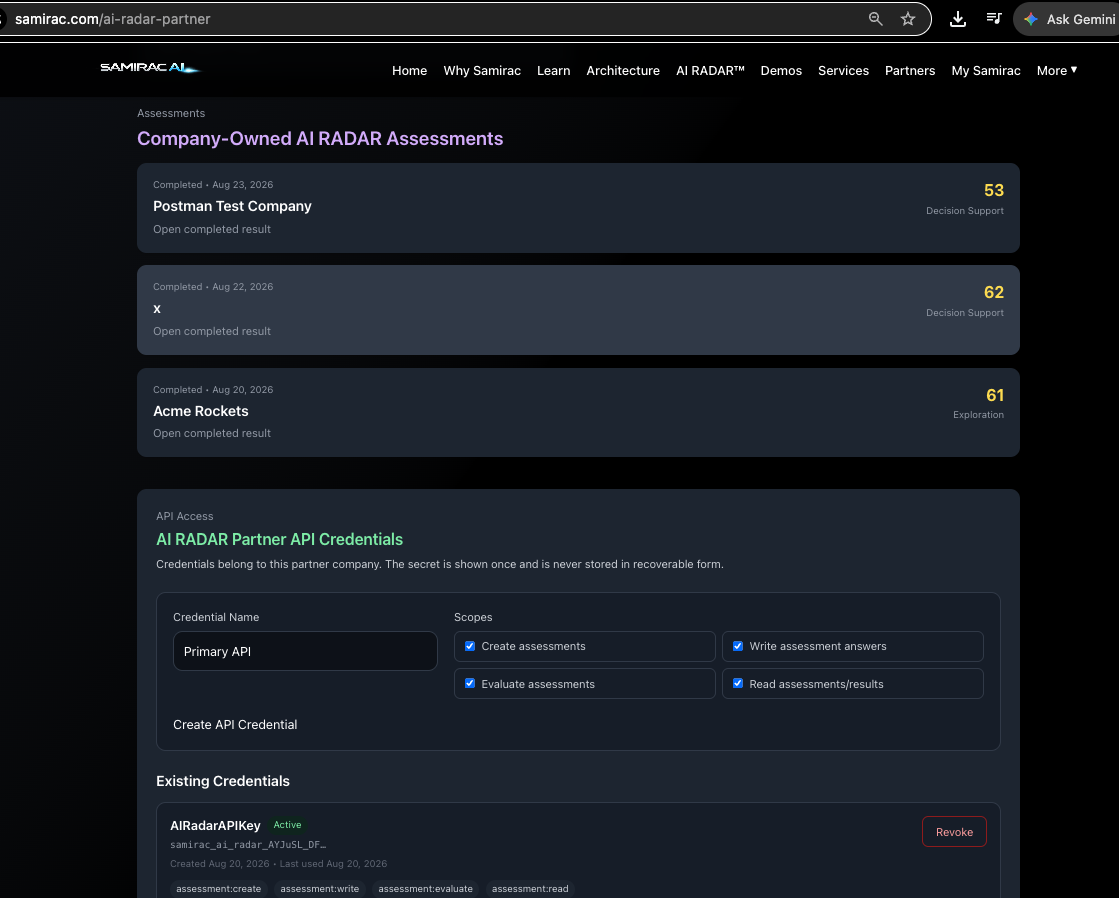
So AI RADAR has a Partner Workspace.
A partner organization can administer assessments across multiple client companies while keeping three different things separate:
Who is administering the work.
Who commercially owns the engagement.
Who is actually being assessed.
That sounds obvious until software collapses all three into one “company” field.
AI RADAR does not.
Partners can see their client organizations, assessment status, completed assessments and results from one workspace.
And the architecture extends beyond the browser.
There Is an API Too
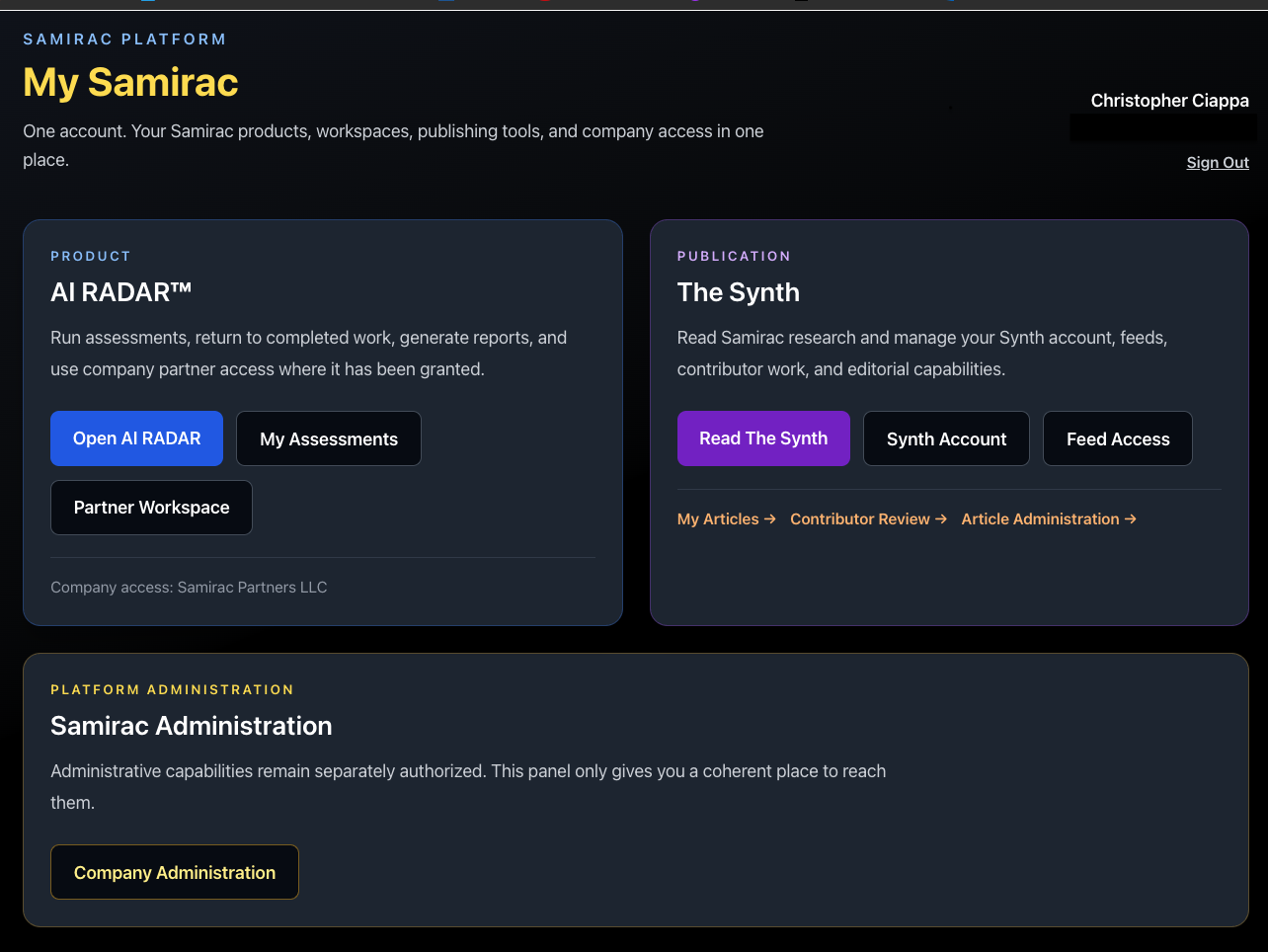
Partner API credentials are company-owned, scoped and independently revocable.
They are not somebody’s login password disguised as an API key.
Access can be scoped separately for creating assessments, writing answers, evaluating assessments and retrieving results.
The API consumes the same canonical AI RADAR definition and the same server-authoritative evaluation system used by the Samirac application.
That was deliberate.
There should not be one definition of AI RADAR for the website and another definition for a partner integration.
The caller supplies the assessment information.
Samirac determines what the assessment means.
Built for Direct Use, Advisory Work and Partner Delivery
This is where I think AI RADAR becomes particularly useful.
A company can use it internally to understand where it stands.
A consultant can use it at the beginning of an engagement.
A technology provider can use it to determine whether the client’s operating environment is actually prepared for what they are about to deploy.
A governance group can use it to expose the difference between documented policy and operational enforcement.
And a partner can incorporate the process into a broader client methodology rather than sending every engagement back to Samirac.
Partner-branded and white-label delivery are part of that direction.
The goal is not to make every partner look like Samirac.
The goal is to give qualified organizations access to the underlying AI RADAR capability while preserving the integrity of the Samirac AI Lifecycle Maturity Model™, the assessment methodology and the authoritative evaluation layer.
Additional white-label, branded-reporting and partner-delivery capabilities will continue expanding from here.
And This Is Not Finished
The important thing is that the foundation is now there.
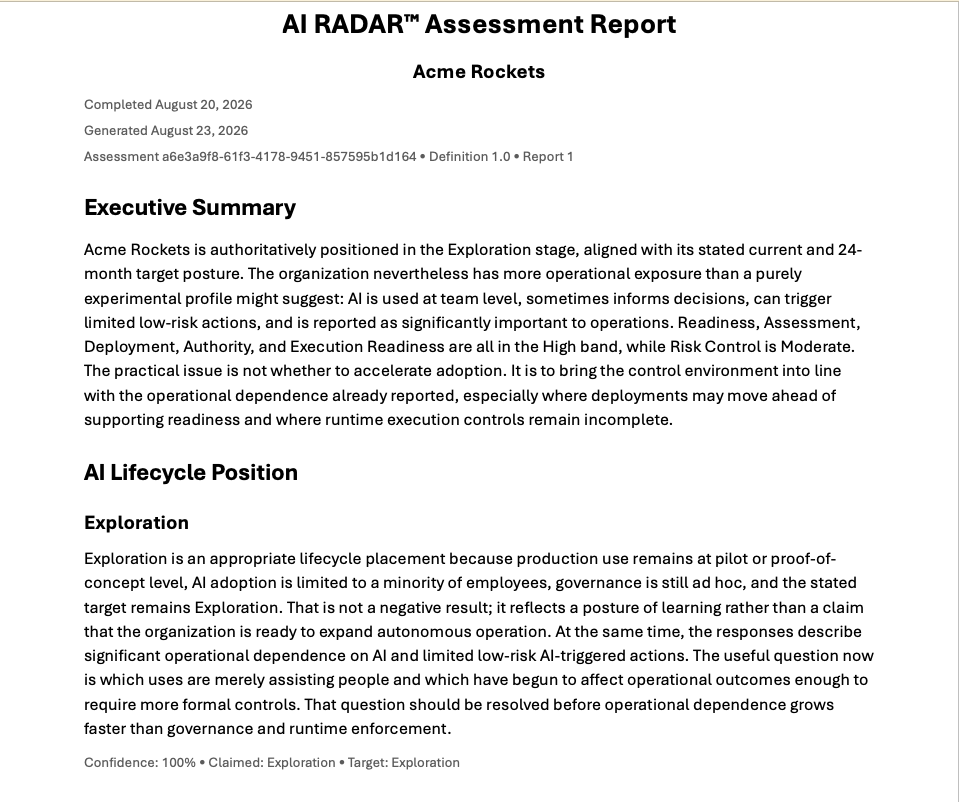
Authenticated users.
Personal and company assessment ownership.
Partner organizations.
Client separation.
Versioned assessment definitions.
Server-authoritative scoring.
Professional generated reports.
Saved report history.
Partner workspaces.
Scoped API credentials.
An API.
That gives us somewhere real to build from.
The next capabilities can now be added without changing what an AI RADAR assessment is every time the product grows.
That opens the door to richer organization portfolio views, comparisons over time, broader integration options, additional reporting and partner-branding capabilities, commercial subscription automation, and deeper lifecycle guidance.
But I did not want to wait until every future button existed before putting the underlying system into use.
AI is already moving into production.
Organizations are already allowing it to influence decisions.
Some are already allowing it to act.
The question is whether the operating architecture around it is advancing at the same speed.
That is what AI RADAR is intended to find out.
Know Where You Are Before You Decide Where AI Goes Next
AI RADAR™ gives organizations and their advisors a structured way to establish current AI maturity, identify the conditions limiting advancement, and determine what needs to change before AI receives greater operational responsibility.
Not another checkbox exercise.
Not a generic maturity score.
A structured assessment tied to an AI lifecycle, an operating architecture, and the point where AI capability becomes real-world consequence.
AI RADAR™ is now available.
For organizations: assess your current position and receive a detailed AI RADAR report.
For consulting and technology partners: ask about partner access, API integration, trials, white-label options and incorporating AI RADAR into your client engagements.
Samirac Partners LLC
AI Lifecycle Maturity Model™ | AI RADAR™ | AI Architecture | Execution Authority
[Start AI RADAR™] [Partner / API Access] [Talk With Samirac]