
Every now and then, something simple lines up so cleanly across domains that you can’t ignore it.
Here’s one of those moments.
Every now and then, something simple lines up so cleanly across domains that you can’t ignore it.
Every now and then, something simple lines up so cleanly across domains that you can’t ignore it.
Here’s one of those moments.
I was looking at different kinds of system failures — AI drift, cognitive breakdown, institutional decay — and the same sequence kept appearing. Five steps. Same order. Every time.
Out of curiosity, I checked something unrelated:
“What are the five stages of economic collapse?”
I wasn’t expecting much.
But what came back was… the same structure again.
Step for step:
Loss of consumer confidence
→ Identity collapse
Market destabilization
→ Frame destabilization
Structural cracks
→ Boundary degradation
Runaway decline / panic
→ Drift accumulation
External rescue or intervention
→ External correction
I didn’t write this.
Economists did.
But it matches the Drift Stack exactly.
At some point, you stop calling this coincidence.
Earlier this week, I showed Claude and Grok two publicly available essays of mine and asked a neutral question:
“Does this framework look valid?”
I didn’t list the five steps.
Didn’t give them the stack.
Didn’t steer them.
Both systems independently produced the same sequence:
Identity
Frame
Boundary
Drift
Correction
Same order.
Same logic.
No coordination between them.
Call it replication, convergence, or just structural consistency — but it’s there.
When the collapse sequence shows up in:
psychology
AI behavior
institutions
quantum analogies
social dynamics
and now macroeconomics
…you’re not just spotting trends.
You’re watching a constraint that appears across coherent systems.
The Drift Stack isn’t “proven.”
But it keeps refusing to break.
If collapse tends to follow a predictable order, then you can:
see it sooner,
interrupt it earlier,
and design systems that don’t drift as easily.
This applies to AI, governance, organizations, families, economies — anything that needs stability.
Sometimes the most useful models aren’t complicated.
They’re just hiding in plain sight.
AI hallucinating? Governance slipping? Architecture feeling fragile?**
If something in your world is wobbling—strategy, teams, tech foundations, organizational sanity, product direction, institutional integrity, early-tech bets, or entire market models—I specialize in rebuilding the Drift Layers that stop systems from falling apart.
👉 This is the work I do: Samirac.com
👉 Book Your Drift Assessment Today: Drift Assessment
This is NOT a sales call.
It’s a quick pattern-level diagnostic to identify which layer your issue sits in:
A1 — Identity
A2 — Frame
A3 — Boundary
A4 — Drift
A5 — External Correction
If there’s a deeper architectural problem, you’ll see it fast.
If not, you walk away with clarity.
Continue reading

AI did not create the borrowed-authority problem. We spent decades building a culture that increasingly rewarded credentials, institutional prestige, titles, language, and visibility as substitutes for demonstrated understanding. Social media monetized that behavior, and generative AI made the performance of expertise almost free. As AI systems gain real authority, the difference between sounding knowledgeable and actually understanding the architecture becomes much harder—and much more important—to ignore.

And by creep, I mean drift or institutional drift.
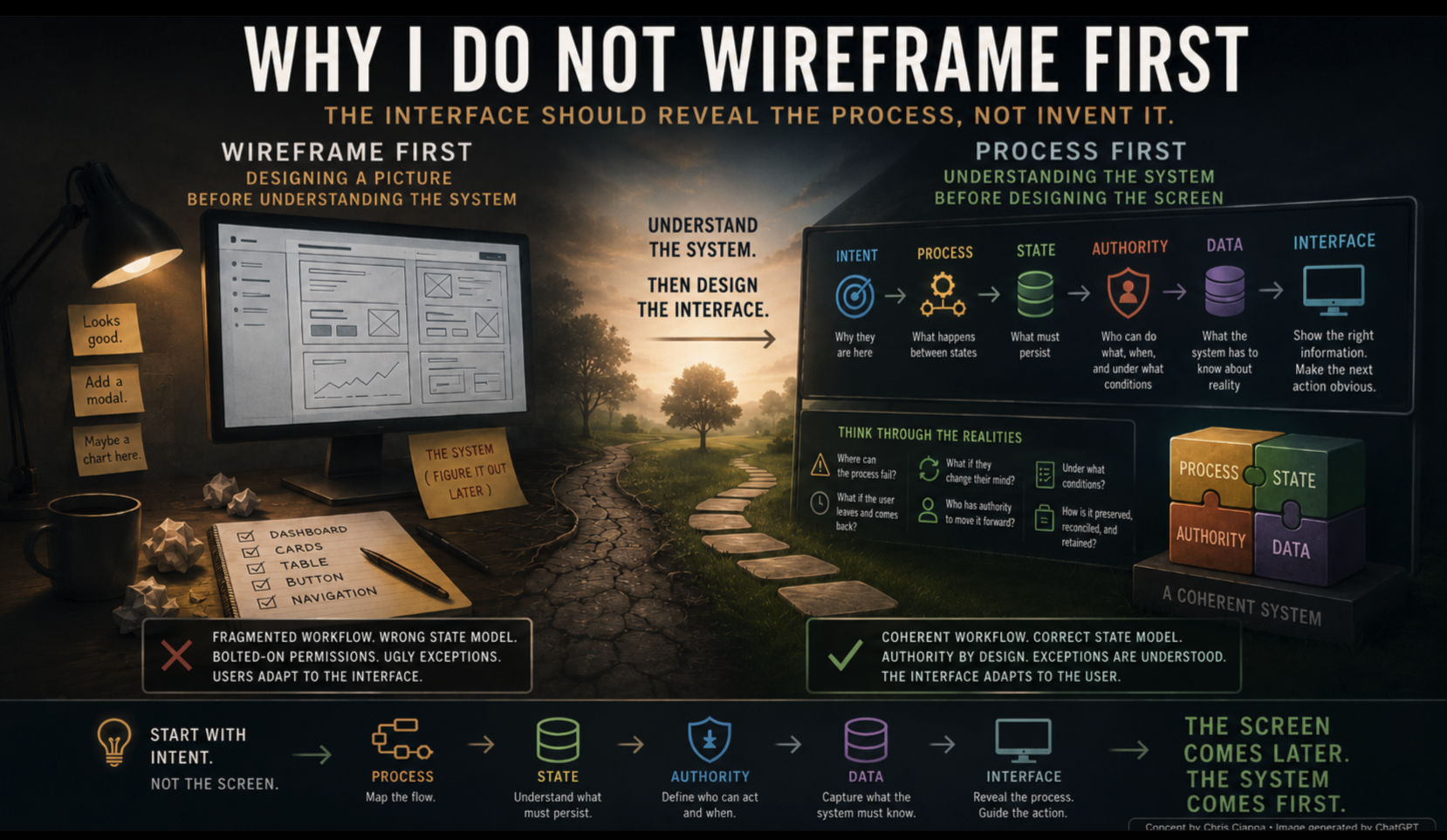
We stopped writing massive Functional and Technical Specifications for good reasons. But somewhere along the way, we also started skipping the thinking those documents forced us to do. This article looks at how that shift shows up in wireframing, rapid prototyping and vibe coding—and why the faster AI lets us build, the more important it becomes to understand the system before we design the screen.