Drift Is Not Uniform — And Now the Architecture Reflects That
Announcing Draft v1.1 of Architectural Drift Management for Adaptive Systems
Chris Ciappa· February 23, 2026· 4 min read
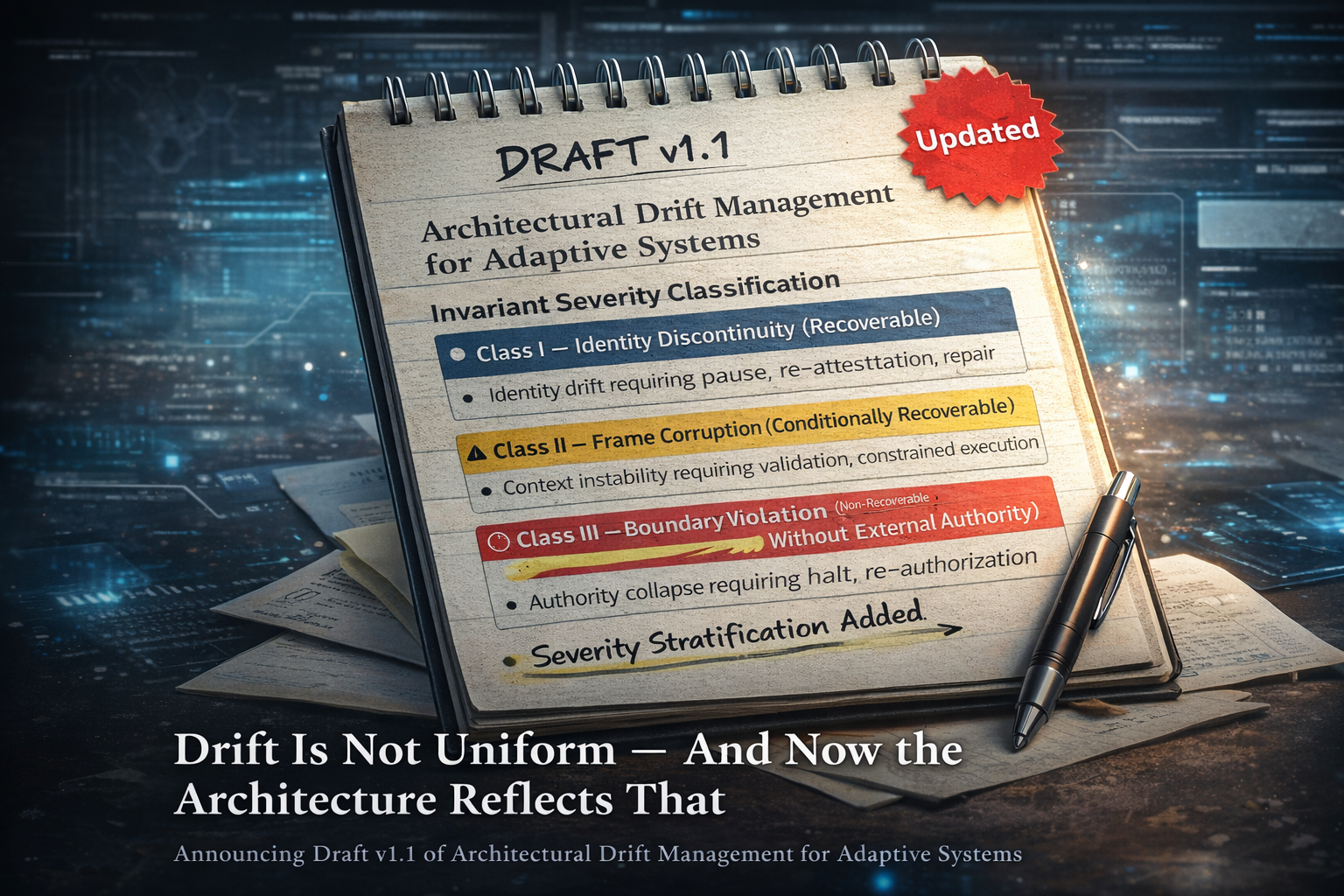
Announcing Draft v1.1 of Architectural Drift Management for Adaptive Systems.
Drift in adaptive systems is inevitable.
But drift is not uniform.
Some deviations are repairable. Some require escalation. Some terminate authority entirely.
The original draft of Architectural Drift Management for Adaptive Systems established a clear position:
Drift is foreseeable. Drift is measurable. Drift must be constrained before execution — not corrected after harm.
Draft v1.1 introduces a structural refinement:
Invariant Severity Classification and Containment Hierarchy.
Not all invariant violations carry the same architectural consequence.
The framework now formally distinguishes:
Class I — Identity Discontinuity (Recoverable) Transient continuity faults requiring pause, re-attestation, and repair.
Class II — Frame Corruption (Conditionally Recoverable) Contextual instability requiring constrained execution and external validation.
Class III — Boundary Violation (Non-Recoverable Without External Authority) Authority collapse requiring immediate halt and mandatory re-authorization.
This refinement closes an important gap:
What happens when stabilization fails?
The Kidney Stone Example Revisited
Last year, I wrote about being asked to confirm my identity seven times before kidney stone surgery.
At every stage, someone scanned my wristband and then asked:
“What’s your name?” “What’s your date of birth?” “What procedure are you here for?”
At the time, I focused on layered verification.
But consider a different scenario.
Imagine they roll me toward the OR and say:
“Tommy Ciappa.”
And I respond:
“That’s not my name.”
That is not a minor discrepancy.
That is not “monitor and continue.”
That is not “allow degraded mode.”
That is a halt.
Because at that moment, execution authority collapses.
His probing around alternative stabilization models surfaced an important refinement: not all invariant violations are equivalent, and recoverability must be explicitly classified.
That line of questioning led directly to formalizing the Invariant Severity Classification and Containment Hierarchy in Draft v1.1 section 3.8.
Intellectual refinement often emerges through disciplined disagreement.
This revision reflects that process.
(For those interested, these are essays worth reading):