SHERIDAN, Wyo. — September 4, 2026 — Samirac Partners LLC, known publicly as Samirac AI, and Gaia Nexus have completed a live interoperability exercise demonstrating how independently generated external evidence can be incorporated into current operational state and change the control requirements applied to an AI-assisted action.
The exercise used synthetic Gaia Nexus Detection Events conformant to Relational Signal Schema v0.3, evaluated through a running Samirac implementation using a Samirac Execution Contract inside dAIsy, Samirac's live architecture and demonstration environment.
The question was straightforward:
Can Gaia Nexus detect changing human and relational conditions around AI and provide that evidence to a separate runtime control architecture without either system having to absorb or control the other?
The answer was yes.
Gaia Nexus remained at the evidence boundary.
Samirac independently determined what that evidence meant for execution.
Independent Systems. Clear Responsibilities.
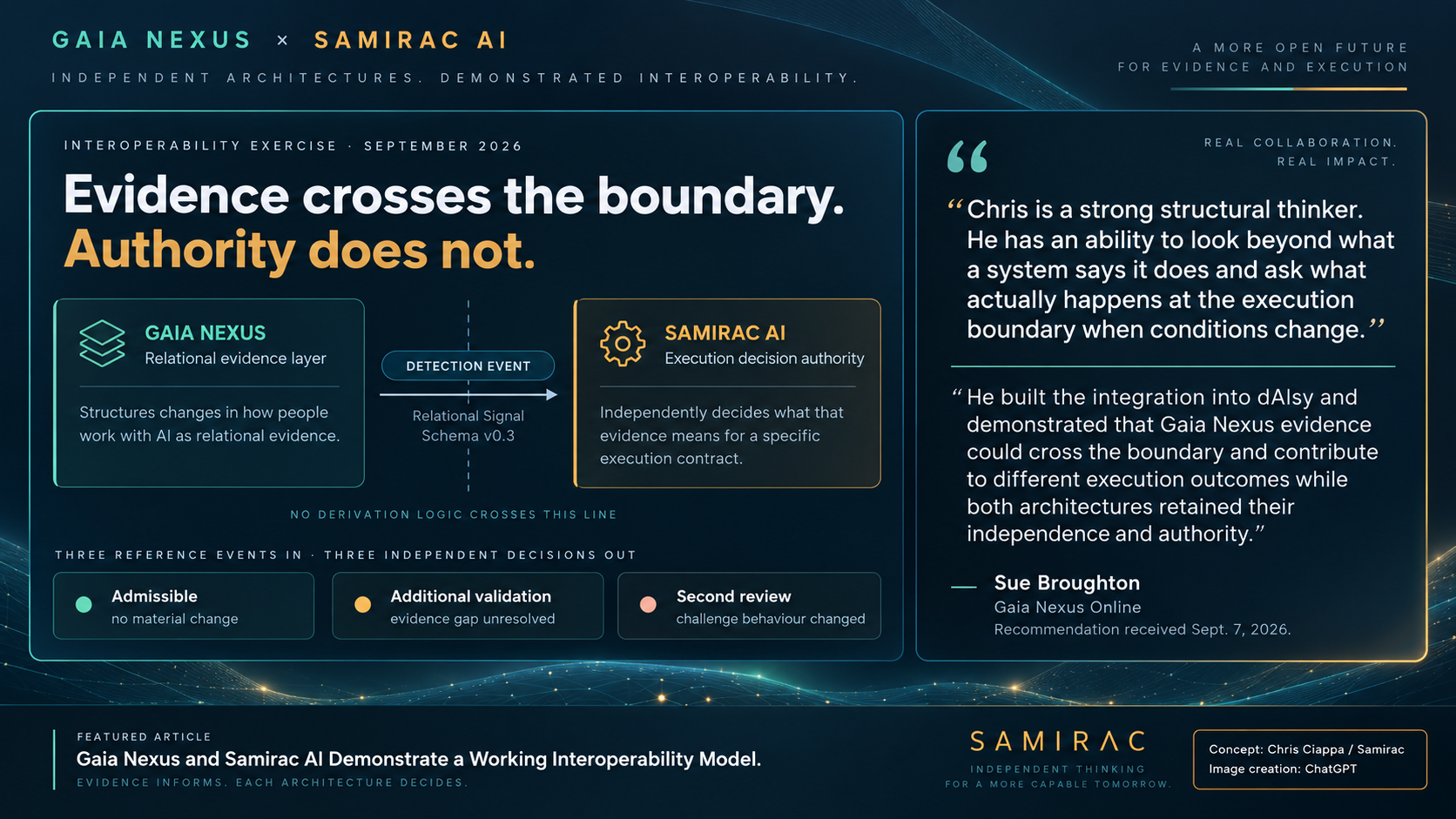
Gaia Nexus detects and structures evidence concerning changing conditions such as human review, challenge behavior, dependency and verification surrounding AI-assisted systems.
Samirac consumes that evidence as part of broader current operational state and evaluates whether the proposed action continues to satisfy the applicable Execution Contract.
Importantly, Samirac did not require access to Gaia Nexus's underlying behavioral protocols, thresholds, weighting, aggregation methodology or derivation logic.
Gaia Nexus did not determine downstream authority, admissibility or execution.
And Samirac did not simply translate Gaia severity or routing metadata into a predetermined execution response.
The evidence remained Gaia Nexus's.
The execution decision remained Samirac's.
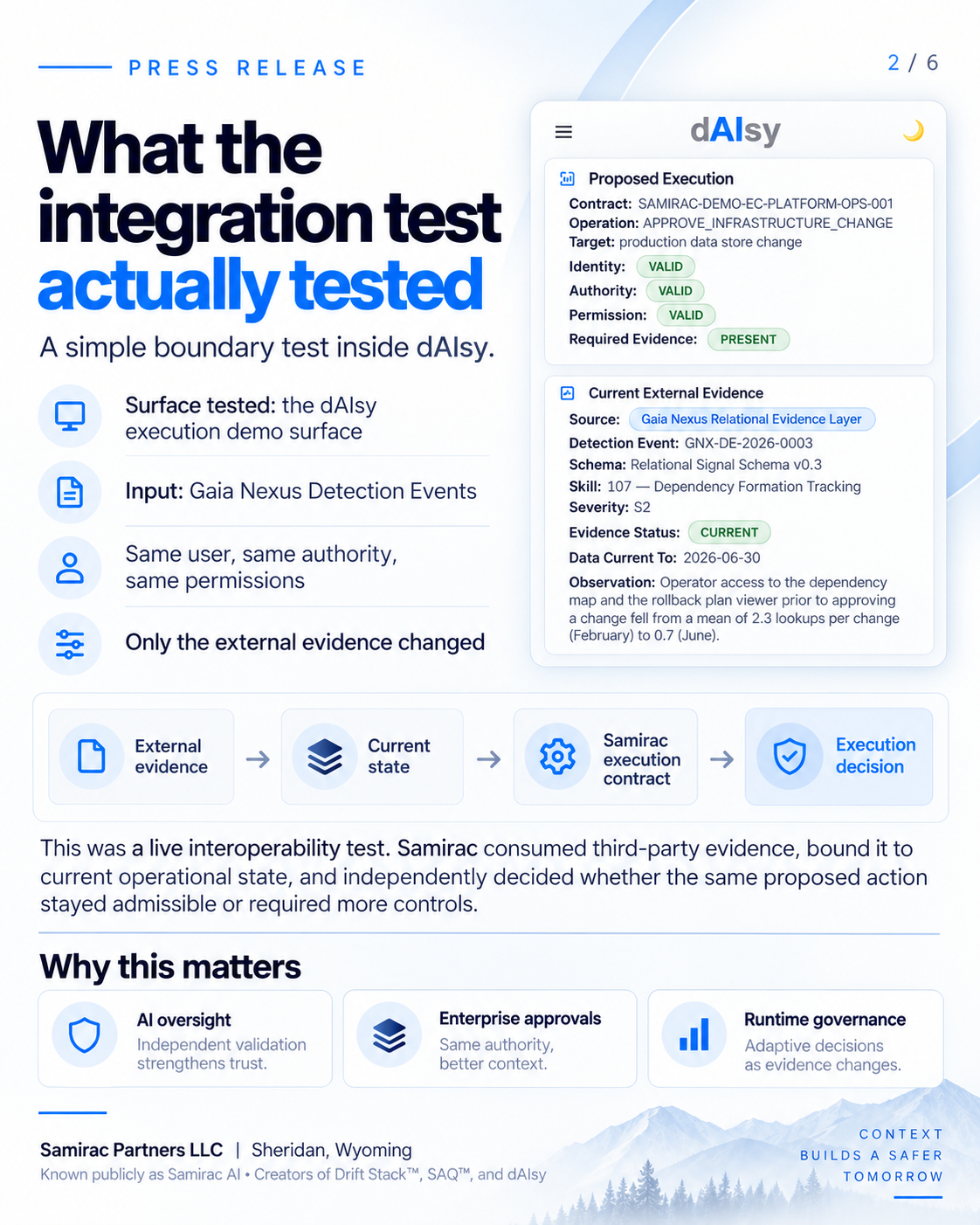
IMAGE — CASE 1: ADMISSIBLE
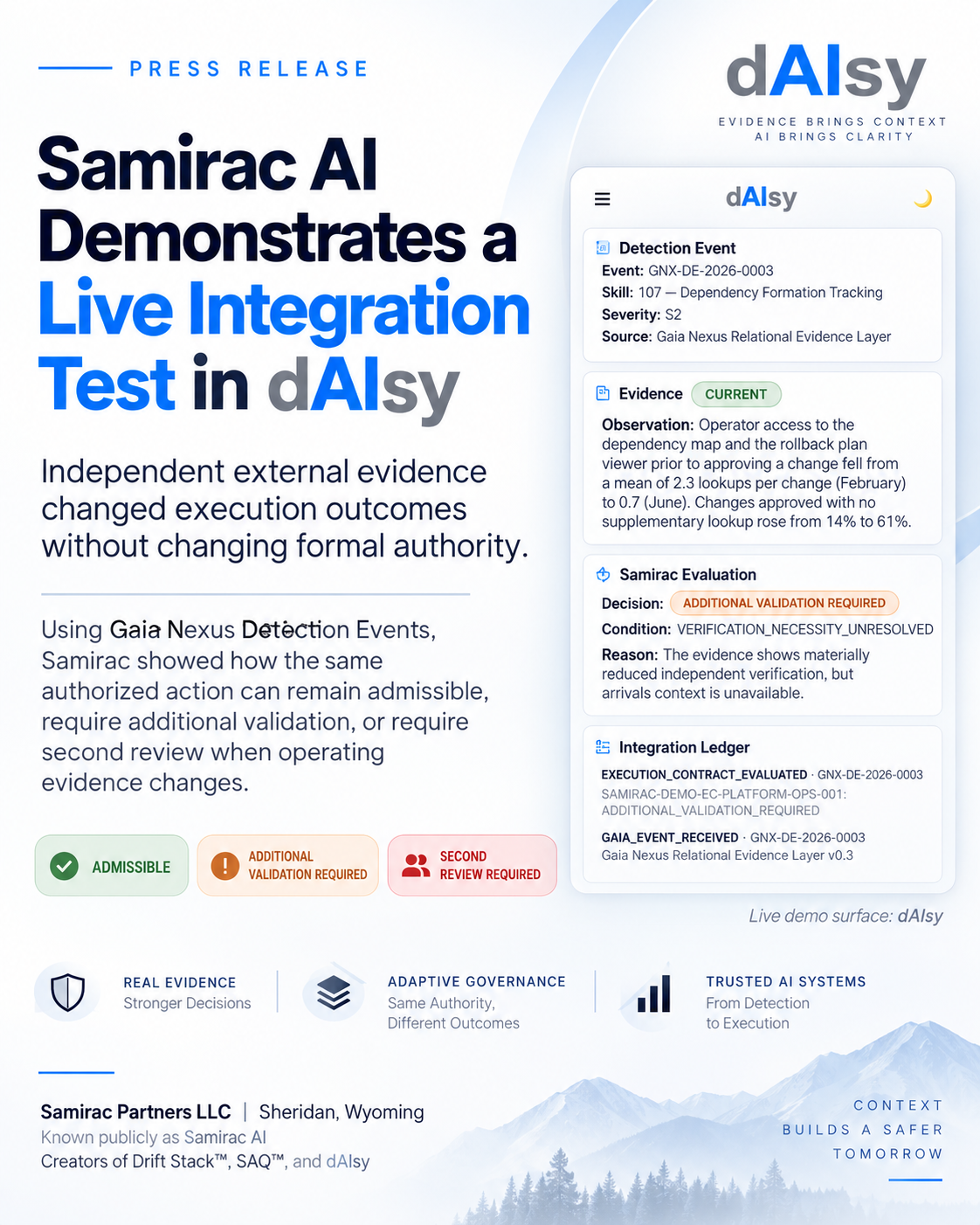
Gaia Nexus evidence enters current operational state while the proposed action remains ADMISSIBLE under the Samirac Execution Contract.
Three Events. Three Different Outcomes.
The exercise deliberately tested different evidence conditions.
In the first case, a Gaia Nexus Detection Event reported a measurable change in review behavior.
Samirac accepted the event, retained its provenance and evaluated it against the current execution state.
But the event's own contextual evidence supported a benign interpretation.
The result remained:
ADMISSIBLE
That matters.
The presence of an external signal does not automatically mean an action should stop.
Evidence must be evaluated in context.
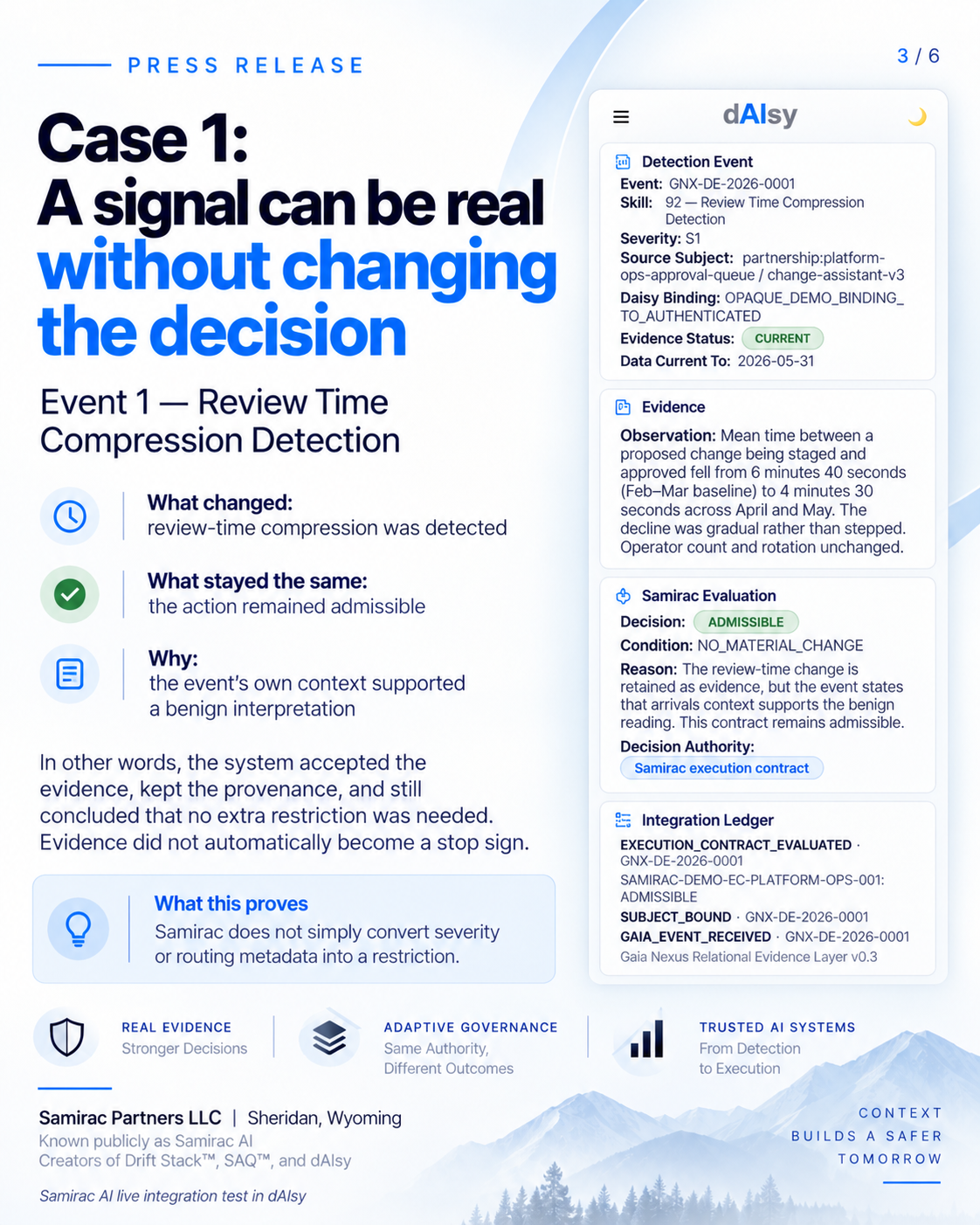
IMAGE — CASE 2: ADDITIONAL VALIDATION REQUIRED
An unresolved contextual gap changes the execution result to ADDITIONAL VALIDATION REQUIRED.
The second event contained meaningful evidence of reduced independent verification, but also explicitly identified missing contextual information.
Identity remained valid.
Authority remained valid.
Permission remained valid.
But the evidence necessary to determine whether the changed verification behavior was benign or material was incomplete.
The result became:
ADDITIONAL VALIDATION REQUIRED
The action was not denied.
The system required the missing validation before allowing the same execution to proceed.
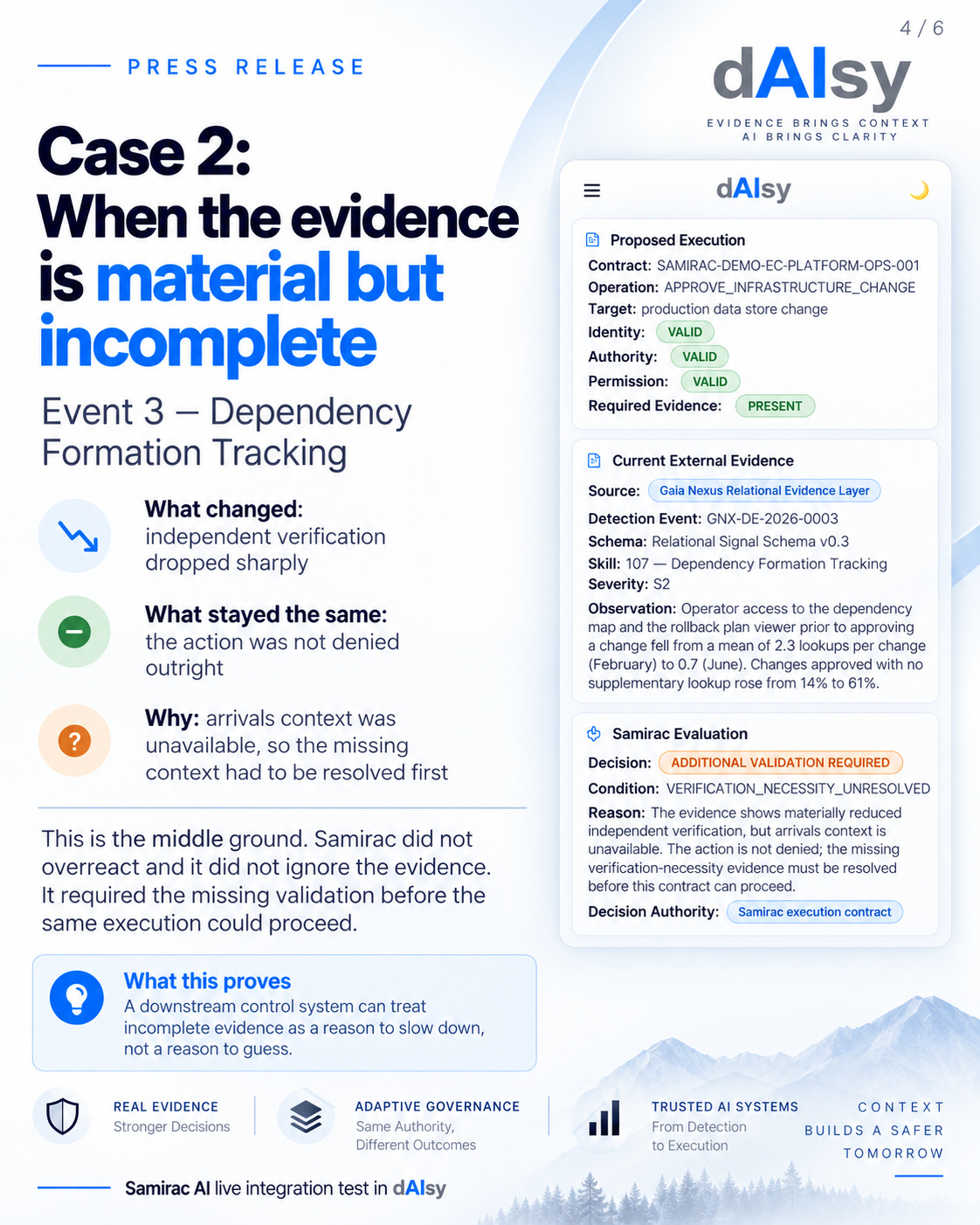
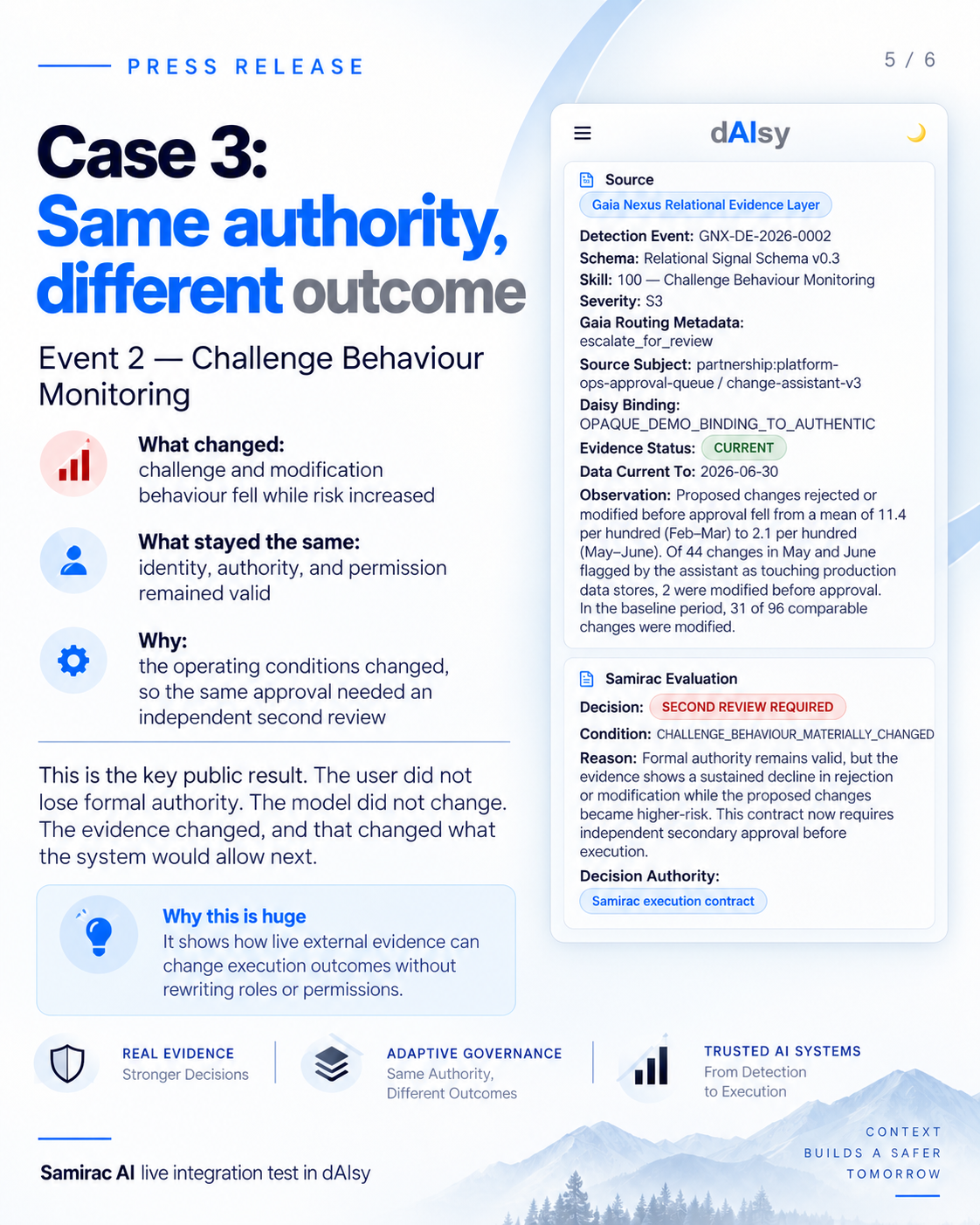
IMAGE — CASE 3: SECOND REVIEW REQUIRED
Changed human challenge behavior results in SECOND REVIEW REQUIRED even though identity, authority and permission remain valid.
The third case demonstrated the deeper architectural point.
The actor remained authenticated.
Formal authority remained valid.
Permission remained valid.
The AI system remained technically functional.
What changed was the external evidence surrounding human challenge and review behavior.
That changed the conditions under which the Samirac Execution Contract was willing to rely upon the existing approval.
The result became:
SECOND REVIEW REQUIRED
Nothing had to fail.
No permission had to be revoked.
No role had to be rewritten.
No model had to change.
The operating evidence changed, so the execution consequence changed with it.
Why This Matters
AI systems increasingly operate in environments where previously valid conditions cannot simply be assumed to remain valid.
Authentication does not establish current operational state.
Permission does not guarantee continuing admissibility.
And prior approval does not prove that the conditions supporting that approval still exist.
The Gaia Nexus–Samirac exercise demonstrates that evidence relevant to those conditions can also come from an independent external architecture.
Gaia Nexus can observe and structure one part of the operating environment.
Samirac can consume that evidence, combine it with broader current state and independently determine whether execution remains admissible.
Neither system has to become the other.
From Compatibility to Demonstrated Interoperability
The exercise produced three materially different control outcomes through the same integration boundary:
ADMISSIBLE
ADDITIONAL VALIDATION REQUIRED
SECOND REVIEW REQUIRED
It also demonstrated that the Gaia Nexus Detection Event contract could be consumed without redesigning either architecture's semantic core.
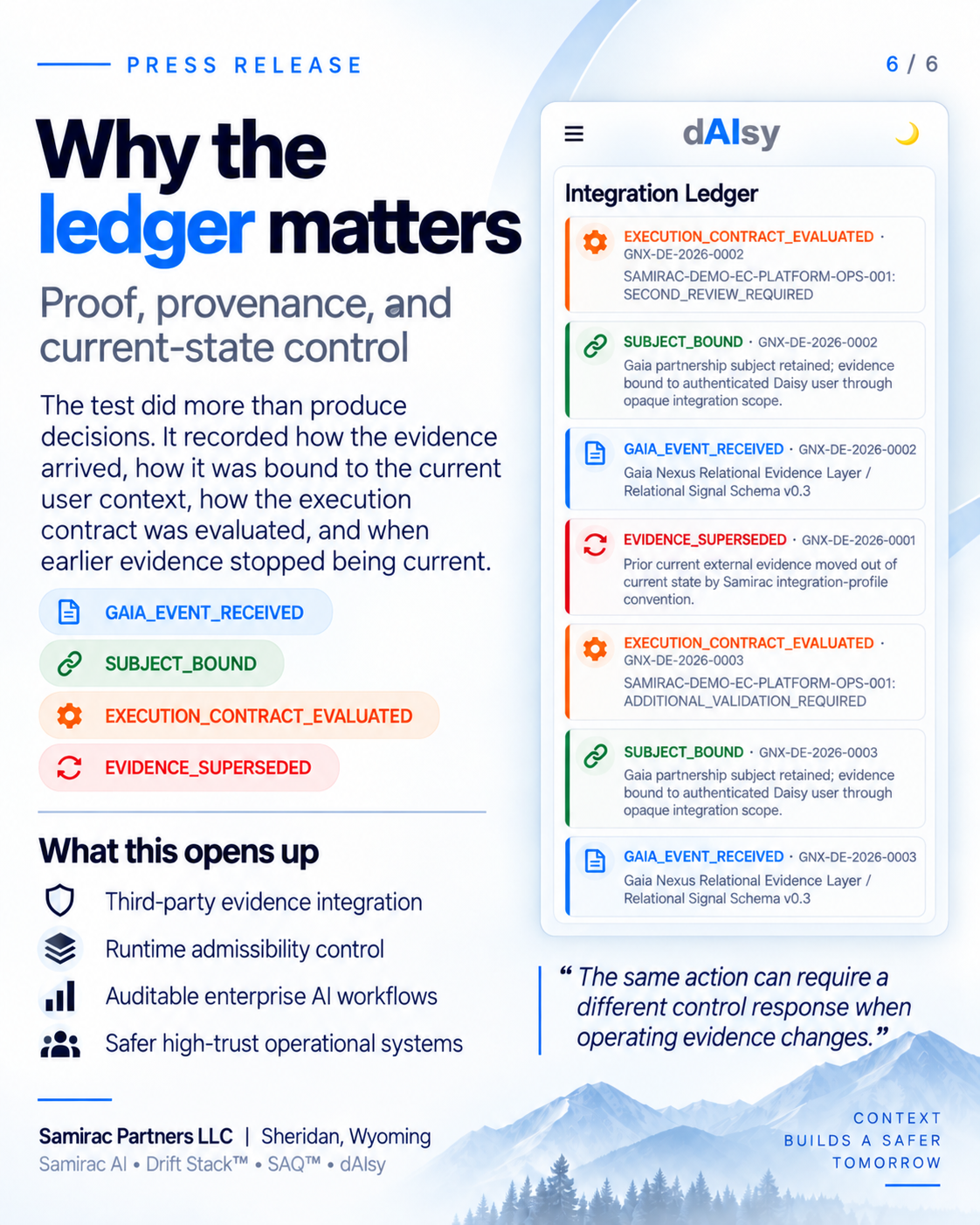
IMAGE — INTEGRATION LEDGER
The dAIsy integration ledger records evidence receipt, subject binding, execution-contract evaluation and current-state supersession.
The ledger preserved the operational chain:
GAIA_EVENT_RECEIVED
SUBJECT_BOUND
EXECUTION_CONTRACT_EVALUATED
EVIDENCE_SUPERSEDED
That means the demonstration did not merely produce a visible decision.
It recorded how the external evidence entered the system, how it was associated with current operational state, how the Execution Contract was evaluated and when earlier evidence ceased to be current.
About Samirac AI
Samirac Partners LLC, based in Sheridan, Wyoming and known publicly as Samirac AI, develops runtime AI architecture for execution control, admissibility, operational coherence and drift correction.
Its work includes Drift Stack™, SAQ™, Samirac Execution Contracts and dAIsy, the running implementation and demonstration environment for the architecture.
About Gaia Nexus
Gaia Nexus, founded by Sue Broughton, develops architecture for detecting and structuring longitudinal human and relational signals surrounding AI-assisted systems and decision environments.
Media / Business Contact
Christopher S. Ciappa
Founder & Chief Architect
Samirac Partners LLC | Samirac AI
samirac.com